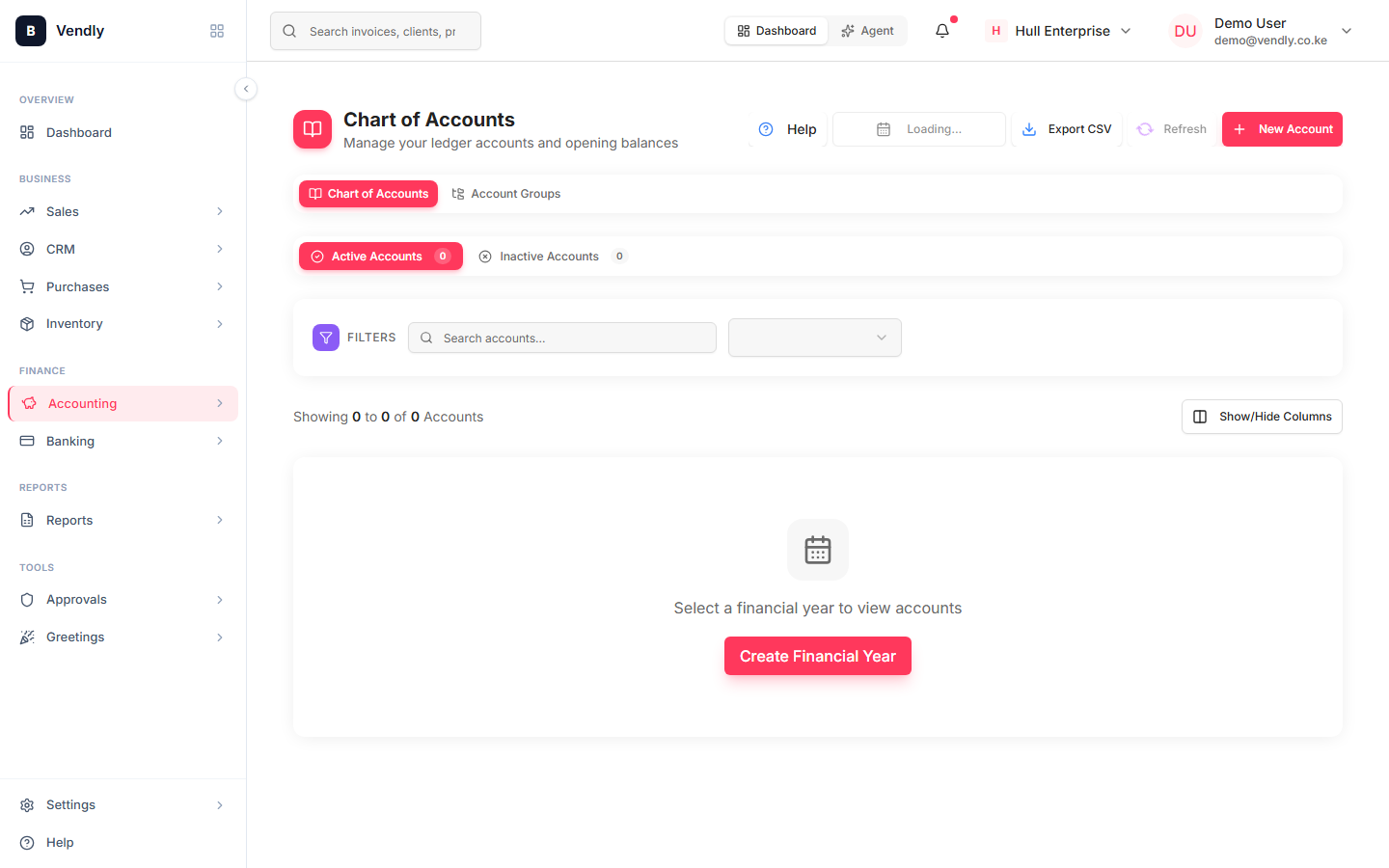
Chart of accounts — types, groups and codes
Five account types and how they ladder up into the balance sheet and P&L. Plus naming conventions that survive growth.
The Chart of Accounts (CoA) is the master list of every account in your books. Every journal entry hits at least two accounts. A clean CoA from day one means clean reports forever; a messy one means reconciliation pain on every month-end.
The five account types
| Type | Normal balance | Lives in | Examples |
|---|---|---|---|
| Asset | Debit | Balance Sheet | Bank, M-Pesa, Receivables, Inventory, Equipment |
| Liability | Credit | Balance Sheet | AP, PAYE Payable, NSSF Payable, Output VAT, Bank Loan |
| Equity | Credit | Balance Sheet | Share Capital, Retained Earnings, Owner's Drawings |
| Income | Credit | Profit & Loss | Sales Revenue, Service Income, Interest Income |
| Expense | Debit | Profit & Loss | Cost of Sales, Salaries, Rent, Utilities, Bank Charges |
Account groups
Groups are the parent / category one level above accounts. They drive the structure of your financial statements — every group of the same type rolls up together. Examples:
- Current Assets (group) → Cash at Bank, M-Pesa Float, Trade Receivables, Stock On Hand…
- Non-Current Assets (group) → Computer Equipment, Furniture & Fittings, Motor Vehicles…
- Trade Payables (group) → AP — Suppliers, AP — Imports, Accrued Expenses…
- Direct Costs (group) → Cost of Goods Sold, Freight In, Import Duties…
Naming conventions that scale
- Lead with the account TYPE word where ambiguous — 'Bank Charges' (expense) vs 'Bank — KCB' (asset).
- Number each account with a 4-digit code matching its group: 1000-1999 Assets, 2000-2999 Liabilities, 3000-3999 Equity, 4000-4999 Income, 5000-9999 Expenses.
- Reserve a sub-range for sub-classifications: 1000 Cash & Bank, 1100 Receivables, 1200 Inventory.
- Don't create one-off accounts. If you billed one client for travel, add it as an Allowance on the invoice, not a new revenue account.
- Mark unused accounts inactive instead of deleting — historical journals still reference them.
Statutory accounts you must have
| Account | Why |
|---|---|
| Output VAT (Liability) | Receives the VAT you charge customers |
| Input VAT (Asset) | Receives the VAT you pay suppliers |
| PAYE Payable (Liability) | Receives the PAYE withheld from each payslip |
| NSSF Payable (Liability) | Tier I + Tier II contributions awaiting NSSF remittance |
| SHIF Payable (Liability) | SHIF contributions awaiting SHA remittance |
| AHL Payable (Liability) | Housing levy awaiting KRA remittance |
| Withholding Tax Payable (Liability) | WHT held back from supplier payments |
| GRN Clearing (Liability) | Bridges goods received vs invoice received timing |
| Inventory Variance (Expense or Income) | Stock-take variances |
Vendly's default Kenya SME chart ships with all of these. Don't delete them even if unused — automatic journal entries reference them by purpose, not by name.
Where to manage your chart
1