
Key takeaways
- What the Budget Allocates
- Jobs Are Real, But They Are Not the Full Answer
- The Affordability Question
- Why Tax Treatment Matters
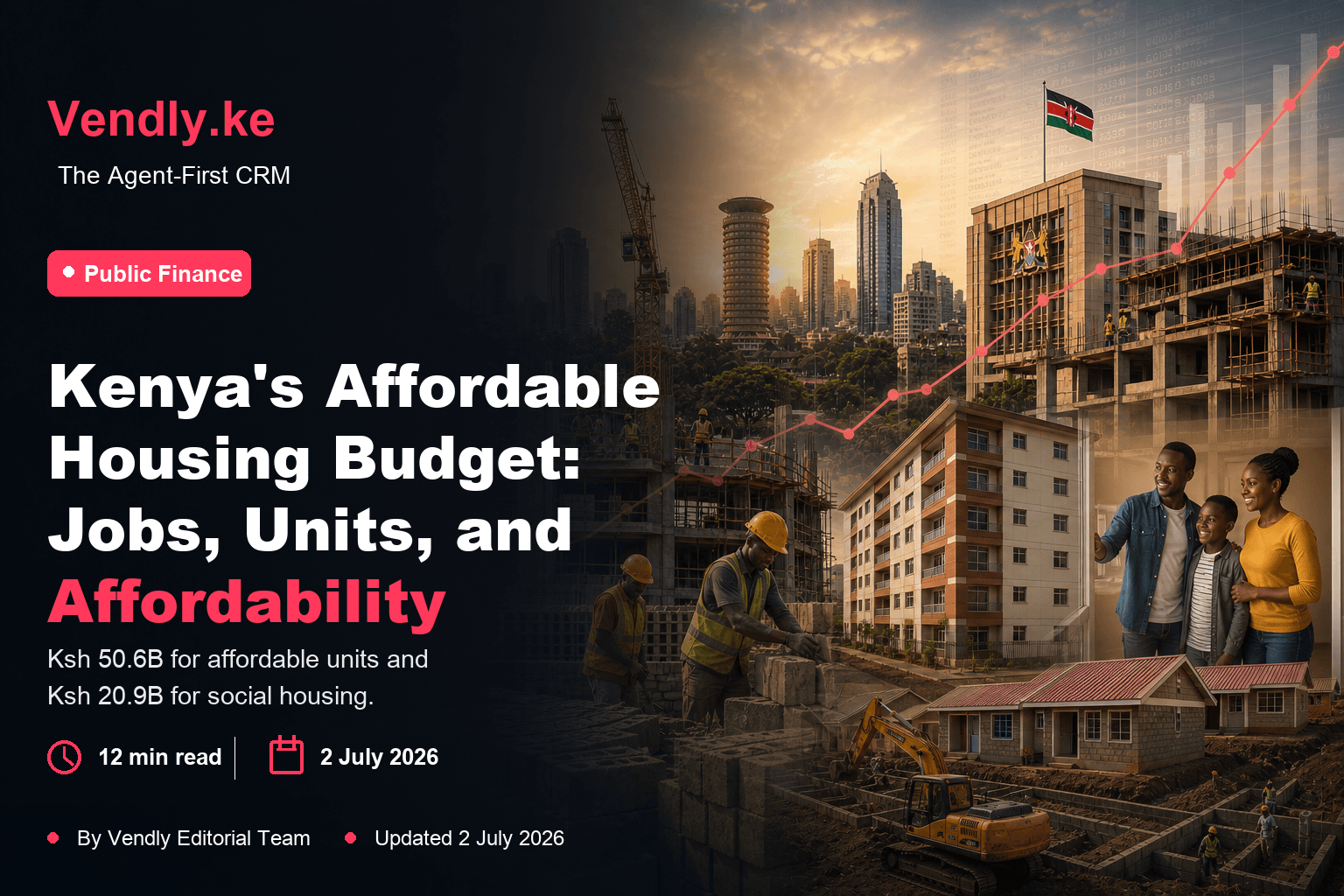
Affordable housing is one of the most visible promises in Kenya's FY2026/27 budget. The National Treasury allocates Ksh 50.6 billion for construction of affordable housing units and Ksh 20.9 billion for social housing units. The wider Housing, Urban Development and Public Works package is Ksh 143.7 billion.
That makes housing more than a construction programme. It is a jobs story, a levy story, a land story, a county urban planning story, and a household affordability story. The Government says affordable housing creates homes while generating direct construction jobs and indirect work in cement, steel, timber, transport, quarrying, professional services, security, cleaning, food vending and site logistics.
The real test is not whether cranes are moving. It is whether completed homes are genuinely affordable for the low- and middle-income Kenyans the programme is meant to serve.
What the Budget Allocates
| Housing item | FY2026/27 allocation | Why it matters |
|---|---|---|
| Affordable housing units | Ksh 50.6 billion | The flagship construction line for units sold under the programme |
| Social housing units | Ksh 20.9 billion | More targeted housing for lower-income households |
| Kenya Urban Programme | Ksh 18.6 billion | Urban infrastructure that determines whether estates are liveable |
| Social and physical infrastructure | Ksh 18.2 billion | Schools, roads, markets, drainage and other supporting facilities |
| Institutional housing | Ksh 20.2 billion | Housing for public institutions and workers |
| Informal settlement improvement | Ksh 2.7 billion | Upgrading pressure points in existing low-income settlements |
The numbers show that Treasury is not only funding apartment blocks. It is trying to fund an urban system around housing: roads, services, public facilities and settlement upgrading. That is important because a cheap unit in a poorly connected estate can still be expensive to live in if transport, water, schools and work opportunities are far away.
Jobs Are Real, But They Are Not the Full Answer
The jobs argument is the strongest short-term case for affordable housing. Construction absorbs labour quickly. A site can employ masons, plumbers, electricians, painters, welders, drivers, security guards, cleaners, food sellers, engineers and architects. It can also create demand for locally produced materials where procurement is structured well.
For SMEs, this matters. A small hardware shop near a site, a quarry transporter, a catering business, a metal fabricator or a cleaning firm can benefit from construction demand. But the jobs story has a weakness: construction jobs can be temporary. If the finished unit remains unaffordable, the programme may create short-term work without solving the housing pressure that justified the spending.
The Affordability Question
Affordability is where the politics becomes uncomfortable. A home is not affordable because the government calls it affordable. It is affordable if a household can pay the deposit, qualify for financing, service the instalments, pay utilities, afford transport and still live without constant financial strain.
A formal worker may have a payslip but still struggle with school fees, food, rent arrears, mobile loans and family obligations. An informal trader may have income but not the clean documentation needed for a mortgage-style purchase. A young worker may want a home but cannot commit to long-term repayment without job security. These are the people the programme must be designed around, not only middle-income buyers already close to the formal credit system.
Why Tax Treatment Matters
Parliament's Finance Bill committee report shows why tax treatment became part of the housing debate. The Ministry of Lands opposed removing VAT relief on goods for affordable housing construction, warning that building materials can be up to 60% of construction costs and that removing VAT relief could raise unit prices by an estimated 8% to 20%. The committee recommended deleting the proposal and preserving the VAT exemption.
The same report discussed exempting the income of the Affordable Housing Fund and Affordable Housing Board from income tax so that money ring-fenced for housing is not recycled back to the exchequer. It also noted a future proposal on input VAT recovery and services used in affordable housing construction. These technical tax details matter because small changes in VAT and input costs can decide whether a unit is affordable or simply cheaper than private-market housing.
Where the Programme Can Leak Value
A housing programme can fail even when buildings are completed. Value can leak through inflated land costs, weak procurement, poor contractor performance, poor quality finishes, delayed utilities, estates built far from jobs, opaque allocation, political targeting, or financing terms that favour people who were already able to buy homes.
The harder question is who benefits first. If suppliers, contractors, financiers and politically connected buyers benefit before the target households, the programme becomes a construction-spending pipeline rather than a housing solution. That is why transparency around unit costs, allocation lists, mortgage terms, rent-to-own terms and resale controls matters.
The Levy Makes Accountability Personal
Affordable housing is not being discussed in a normal budget environment. Workers and employers already understand the Affordable Housing Levy as a monthly deduction and cost. That makes accountability more personal than an ordinary development vote. When a salaried Kenyan sees a deduction every month, they want to know whether it is producing homes they can realistically access, not only estates they see in launch photos.
For employers, the levy is also part of the cost of formal labour. It sits beside PAYE, SHIF/SHA, NSSF and other payroll obligations. The more payroll costs rise, the more businesses think carefully about hiring, salary increments and formal contracts. That does not mean the levy cannot be justified. It means the programme must show visible public value because businesses and workers are already paying before many of them can see a unit they can buy.
Social Housing Must Not Be Lost in the Headline
The Ksh 20.9 billion social housing allocation deserves its own attention because it speaks to households that are furthest from the formal mortgage market. Social housing should not be treated as a smaller cousin of affordable housing. It is the part of the programme that asks whether Kenya can provide decent housing for people whose income is irregular, low or undocumented.
If social housing is badly located or poorly maintained, it can reproduce the same problems it is meant to solve: long commutes, weak services, insecure tenure and overcrowding. If done properly, it can reduce pressure in informal settlements, improve sanitation, support public health and give workers a more stable base near jobs and transport.
The SME Supply Chain Test
Housing can create work for SMEs, but only if procurement is not locked up by large contractors and their preferred suppliers. A public housing site needs cement, ballast, sand, steel, timber, paint, electrical fittings, plumbing materials, windows, doors, transport, meals, safety equipment and site services. Many of those inputs can come from local businesses if the procurement rules and payment systems allow them to participate.
The risk is that small suppliers deliver materials and then wait months for payment because the main contractor, board or public agency is slow. That turns a public project into a private cash-flow problem. For construction SMEs, the practical discipline is clear: do not supply on handshake terms, keep signed delivery notes, reconcile invoices quickly, track retention money and avoid taking on debt against payments that are not contractually secure.
Affordability Is More Than the Selling Price
A good housing policy must look beyond the sticker price. A Ksh 1 million or Ksh 2 million unit may sound affordable compared with private apartments, but a household still has to handle deposit, monthly repayments, service charges, electricity, water, transport, food, school costs and emergencies. If the estate is far from work, the transport bill can quietly cancel the benefit of a cheaper unit.
This is why urban planning matters. Housing near jobs, schools, clinics, markets and public transport is more affordable than a cheaper unit that pushes a worker into long daily travel. Treasury's allocations to urban infrastructure and social and physical infrastructure should therefore be watched together with the unit allocations. A home without services is not affordable in real life.
What Kenyans Should Watch
- 1Unit price: The completed price should match incomes of the target households, not just be lower than luxury private housing.
- 2Location: Homes should reduce living pressure, not push workers farther from jobs and transport.
- 3Allocation rules: Buyers and tenants should be selected through a transparent system.
- 4Quality: Cheap units become expensive if repairs, water, drainage and maintenance fail early.
- 5Supplier payments: Contractors and SMEs should be paid on time to avoid turning public housing into private debt.
- 6Jobs created: The programme should publish direct and indirect job data by project and county.
- 7Affordability after tax relief: VAT and other incentives should show up in lower unit prices, not only in project margins.
The Bottom Line
Kenya's affordable housing budget can be defended if it delivers three things at once: liveable homes, real jobs and prices that low- and middle-income households can carry. If it delivers only construction activity, then public money and levy contributions will have funded movement without solving the household problem.
The fair test is simple. When the units are complete, can the intended Kenyan family afford to move in, stay there and build a life without being squeezed by transport, utilities and debt? That answer will tell us whether affordable housing is becoming housing policy or just another expensive construction line.