Key takeaways
- Where the Gap Sits in the Budget
- Why the Deficit Matters Beyond the Headline
- Most of the Gap Will Come From Local Borrowing
- What Local Borrowing Looks Like on the Ground
Kenya's FY2026/27 budget has one uncomfortable fact at its centre: Treasury wants to spend much more than it expects to collect.
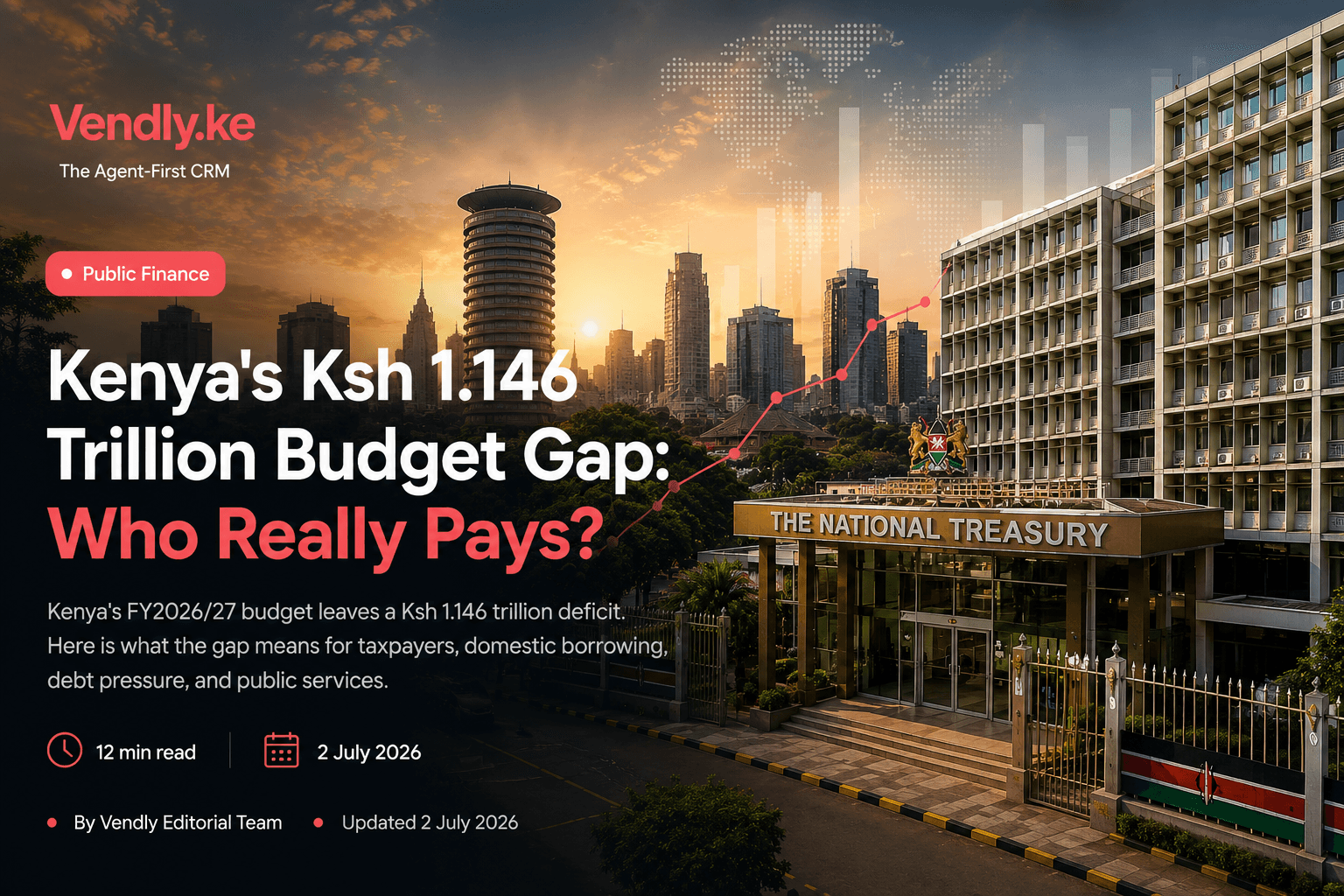
In the National Treasury's Mwananchi Guide, total government expenditure and net lending is Ksh 4.8204 trillion. Total revenue, including Appropriations-in-Aid, is projected at Ksh 3.6305 trillion, while grants add Ksh 43.6 billion. The shortfall is Ksh 1.1462 trillion, equal to 5.5% of GDP.
Put it in ordinary budget language: for every Ksh 100 the government wants to spend, about Ksh 75 comes from revenue, about Ksh 1 comes from grants, and roughly Ksh 24 has to be borrowed.
That is the real story of the 2026/27 budget. It is not only about which ministry received what. It is about who carries the missing Ksh 1.146 trillion after the Budget Speech is done and the headlines have moved on.
A deficit is not automatically bad. Kenya has borrowed before to build roads, fund energy projects, respond to droughts, and keep essential services running. The issue this time is the size of the gap, how much of it will be borrowed locally, and how much of the budget is already tied up in interest payments, pensions, and other obligations that cannot be postponed easily.
For a business owner in Nairobi, Kisumu, Eldoret, Mombasa, Nakuru, or any county town, this can sound like Treasury Building language until it lands in the real world: loan rates, supplier prices, delayed county payments, KRA follow-ups, slower customer spending, and tighter cash flow. That is why this article treats the deficit as a business issue, not just a public finance statistic.
Where the Gap Sits in the Budget
| Budget item | FY2026/27 amount | What it means |
|---|---|---|
| Total expenditure and net lending | Ksh 4.8204 trillion | What the government plans to spend before filling the gap |
| Total revenue including AIA | Ksh 3.6305 trillion | What Treasury expects to collect directly |
| Grants | Ksh 43.6 billion | External support, useful but small compared with the full budget |
| Fiscal deficit | Ksh 1.1462 trillion | The amount Kenya must finance after revenue and grants |
| Net domestic financing | Ksh 1.03 trillion | The main borrowing source, raised from the local market |
| Net foreign financing | Ksh 116.2 billion | The smaller borrowing share, raised externally |
Why the Deficit Matters Beyond the Headline
The headline number tells us Treasury must find Ksh 1.1462 trillion after revenue and grants. The deeper question is whether the borrowing creates enough value for Kenyans to justify the cost. Borrowing for a road that reduces transport costs, a power project that improves reliability, or a health system that actually works is different from borrowing to keep covering the same operating gaps year after year.
This is where Kenya's budget debate becomes sharper. The same budget promises roads, rail, energy, education, health, housing, agriculture, and digital infrastructure. But it also carries a large fixed-cost burden. Interest payments and pensions are not like a new project that can be delayed for a year. Once they are due, they sit at the front of the queue.
The real question is not simply whether Kenya should borrow. It is whether the borrowing grows the economy faster than interest costs eat into future budgets.
Most of the Gap Will Come From Local Borrowing
The most important detail is not only the size of the deficit. It is where Treasury plans to get the money. The budget shows Ksh 1.03 trillion in net domestic financing and Ksh 116.2 billion in net foreign financing. In plain terms, close to 90% of the deficit financing is expected to come from inside Kenya.
That usually means Treasury bills and Treasury bonds bought by banks, pension funds, insurers, money market funds, asset managers, SACCO-linked institutions, and other local investors. The money is not floating somewhere far away. It is coming from the same financial system that also serves businesses and households.
There is a benefit to borrowing in shillings: Kenya avoids some foreign exchange risk because that portion is not repaid in dollars or euros. But there is a trade-off. When the government is a heavy borrower in the same market where businesses are looking for credit, money can move toward government securities instead of private lending.
What Local Borrowing Looks Like on the Ground
Local borrowing sounds technical, but the chain is simple. Treasury issues bills and bonds. Financial institutions and investors buy them. The government receives cash now and promises to repay later with interest. Those investors include the same institutions that influence ordinary business finance: commercial banks, pension schemes, insurers, money market funds, and asset managers.
If government paper is offering a decent return with lower risk, a lender has an easy option. That does not mean every bank stops lending to businesses. It means the benchmark changes. A small manufacturer in Industrial Area, a pharmacy in Kisii, or a wholesaler in Nyeri asking for working capital is competing against a safer investment backed by the state.
For formal businesses, this can show up in loan pricing, collateral requirements, approval timelines, and how willing banks are to finance sectors they consider risky. For micro and informal traders, it may show up indirectly: suppliers reduce credit, wholesalers demand faster payment, and customers delay purchases because household budgets are stretched.
Why Kenyan SMEs Should Care
This budget gap is not just a Treasury problem. It affects the person running payroll, the accountant preparing VAT, the contractor waiting for a county payment, and the shop owner trying to restock before schools reopen. If the government absorbs a large amount of local financing, banks may prefer lending to the state because it is safer than lending to a small business.
This creates a tension inside the budget. Treasury recognizes that MSMEs face limited affordable credit, high interest rates, weak market access, and low technical capacity. At the same time, the same fiscal plan asks the local market to finance a very large public borrowing need.
For SMEs, the question is not academic: if more local savings go into government paper, how much remains for stock financing, payroll gaps, LPO financing, equipment loans, and expansion?
| Budget pressure | How it can reach SMEs | What to monitor |
|---|---|---|
| Heavy domestic borrowing | Banks and funds put more money into Treasury bills and bonds | Loan approval rates, interest rates, collateral requirements |
| Stronger tax enforcement | More KRA data matching through eTIMS, iTax, PAYE, bank, and third-party records | Clean invoices, payroll filings, VAT returns, and withholding tax records |
| Debt service pressure | Less fiscal room for new supplier payments, county transfers, and development projects | Government receivables, public-sector contracts, county payments, and payment timelines |
| Cost-of-living pressure | Households become more cautious with non-essential spending | Sales mix, stock turnover, customer payment behaviour |
Debt Is Already Competing With Services Kenyans Use
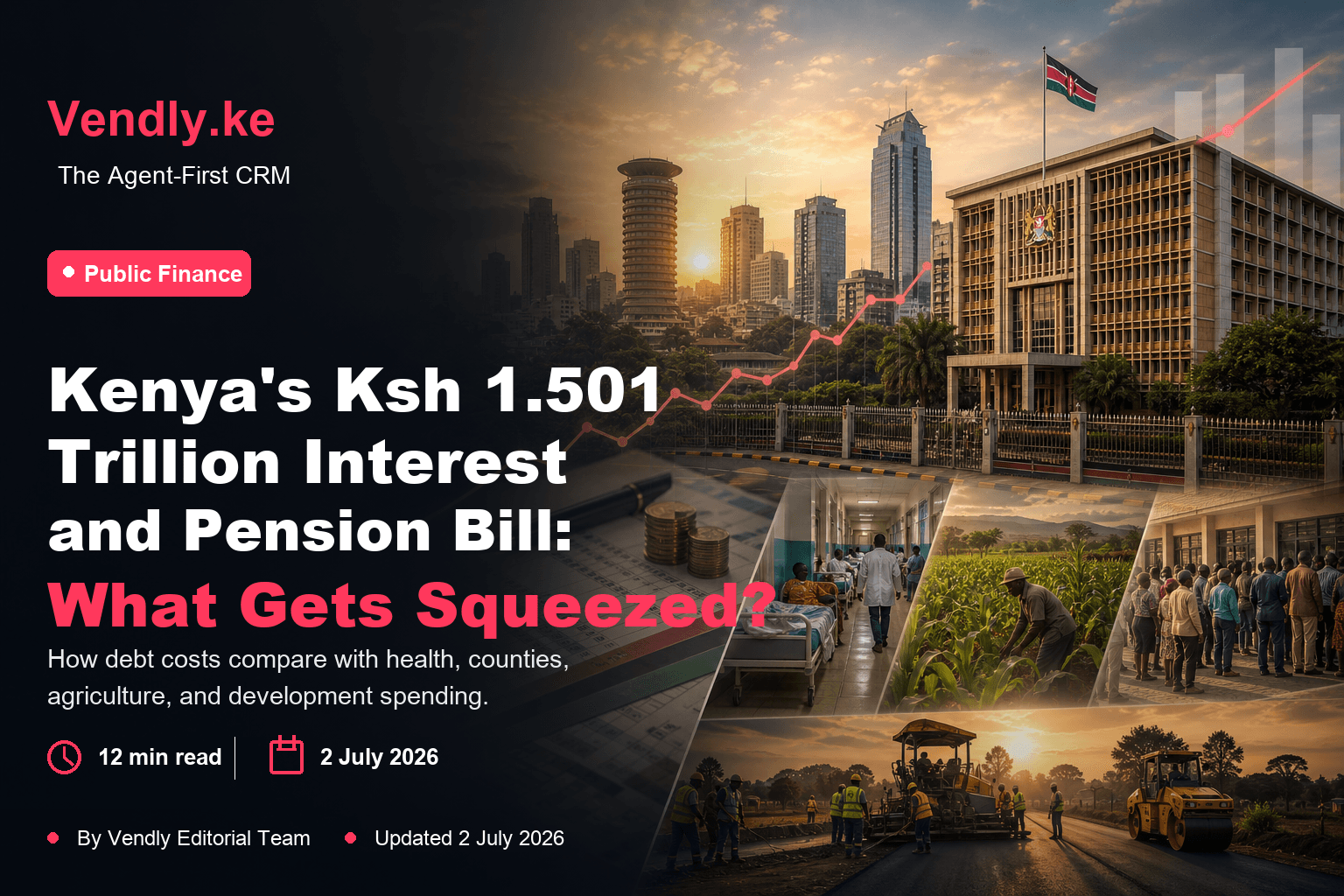
The budget also shows how past borrowing shapes today's choices. Interest payments and pensions are allocated Ksh 1.5013 trillion. That is larger than the education allocation of Ksh 784.5 billion, larger than Energy, Infrastructure and ICT at Ksh 531.3 billion, and more than three times the counties' equitable share of Ksh 428 billion.
That does not mean schools, counties, hospitals, or roads were ignored. It means debt obligations and pensions have become one of the biggest fixed claims on public money. Before Kenya funds new roads, medical supplies, classrooms, agriculture programmes, or housing projects, a large portion of the budget is already spoken for.
This is why budget debates can feel frustrating to ordinary Kenyans. A patient may wonder why a county hospital lacks supplies. A headteacher may ask why capitation is not enough. A contractor may be waiting months for payment. The answer is rarely one line item. It is the accumulated effect of revenue limits, debt service, pensions, wages, pending bills, and political commitments competing for the same shilling.
For counties, the Ksh 428 billion equitable share is significant, but counties carry frontline responsibilities in health, agriculture, water, early childhood education, local roads, markets, and trade services. When national-level debt service takes up more of the money available, the pressure can move downward into devolved services even when the county allocation looks large on paper.
Who Actually Pays the Deficit?
Taxpayers pay first. The Finance Act 2026 and KRA's wider compliance direction point toward more data-driven tax administration, eTIMS, pre-populated returns, third-party data, and stronger enforcement. Even where headline tax rates do not jump dramatically, tighter enforcement can bring more businesses and individuals into the tax net.
Borrowers pay second. Heavy local borrowing can influence credit conditions. If Treasury bills and bonds remain attractive, lenders may prefer safer public debt over private-sector lending, especially for small firms without strong collateral, audited accounts, or clean repayment history.
Future budgets pay third. Borrowing closes today's gap, but repayment and interest come back later. If revenue growth does not outrun debt-service pressure, future budgets will have less room for development spending.
Tax Compliance Will Carry More Weight
The Finance Act 2026 sits inside this larger fiscal story. When the government needs more revenue but wants to avoid politically explosive tax increases, compliance becomes the quieter but powerful tool. KRA can collect more by widening the base, reducing under-declaration, matching data, and making it harder to trade outside the documented economy.
For compliant businesses, this can be positive if it reduces unfair competition from traders who avoid tax and undercut prices. But the transition can still be painful. Businesses that treat invoicing, payroll, VAT, withholding tax, and bank reconciliation as loose back-office tasks will face more risk as systems begin comparing records automatically.
- Sales invoices should match VAT and income records, not just exist as documents sent to customers.
- Payroll records should reconcile PAYE, SHIF/SHA, NSSF, and Affordable Housing Levy liabilities against actual payments.
- Withholding tax deductions should be tracked by supplier and certificate, not handled as a vague deduction in the books.
- M-Pesa, bank, and cash collections should reconcile to sales records before tax filing deadlines.
- Credit notes, refunds, cancelled invoices, and bad debts should have evidence because they affect taxable revenue.
This is why budget pressure connects directly to business systems. When revenue targets rise, the government has an incentive to make tax administration more data-driven. The businesses that cope best are the ones with clean records before KRA asks questions.
The Pressure Transfer Chain
The deficit works like a pressure chain. If revenue underperforms, pressure moves to borrowing. If borrowing rises, pressure moves to interest costs. If interest costs rise, pressure moves to services, counties, development projects, and taxpayers.
That is why the Ksh 1.146 trillion deficit is more than an accounting shortfall. It is a signal about the future cost of today's spending plan.
What Would Make the Gap Safer?
A large deficit becomes less dangerous if it is matched by credible growth, disciplined spending, and transparent execution. If borrowed money improves roads, energy reliability, ports, digital infrastructure, education quality, and health access, the economy can become more productive and generate more future revenue. If the money disappears into inefficiency, stalled projects, weak procurement, and day-to-day costs, Kenyans are left with the bill but not the productive base.
Three things matter. First, development spending must be protected from leakages and stalled projects. Second, tax collection should grow through real economic activity and better compliance, not only by squeezing the same formal taxpayers harder. Third, local borrowing should avoid starving the private sector of affordable credit, especially where businesses are creating jobs and export earnings.
What Kenyans Should Watch During FY2026/27
Budget numbers are promises until implementation starts. The real story will unfold month by month. Businesses and citizens should watch whether ordinary revenue meets target, whether local borrowing rises above plan, whether pending bills grow, and whether supplementary budgets add new spending pressure.
- 1Revenue performance: If actual collections fall below target, the deficit may widen or spending may be cut.
- 2Local borrowing appetite: If Treasury needs more from the local market, private-sector credit conditions may tighten.
- 3Interest-rate direction: Higher borrowing costs would make the deficit more expensive in future budgets.
- 4County disbursement timing: Delays can affect health facilities, suppliers, contractors, markets, and local services.
- 5Development project execution: Borrowing is easier to justify when projects are completed and visibly improve productivity.
- 6KRA enforcement tone: More automated assessments and data matching will change compliance risk for SMEs.
The Real Test Is Discipline
Treasury projects the fiscal deficit will decline from 5.5% of GDP in FY2026/27 to 3.3% by FY2028/29. That is the promise. The real test is whether government can slow down day-to-day spending, collect more tax without punishing businesses that are already compliant, cut wastage, and avoid supplementary budgets that quietly push the gap back up.
For Kenyans, the budget gap answers a bigger question than which sector received which allocation. It shows how public promises are financed, who pays today, and what future budgets may have to sacrifice.
The answer is clear: taxpayers pay now, borrowers feel it next, and future budgets carry the rest.
For Kenyan SMEs, the practical response is not to wait for the macro picture to become perfect. It is to strengthen cash-flow planning, keep cleaner books, monitor tax exposure monthly, separate business and personal money, and avoid making expansion decisions based only on optimistic sales projections. In a tight public finance environment, the businesses that survive are often the ones that see their numbers early and adjust before pressure becomes a crisis.