Key takeaways
- Where the Ksh 784.5B Goes
- TSC Is the Centre of the Budget
- Capitation Is Where Schools Feel the Budget
- Junior Secondary Is Still the Pressure Point
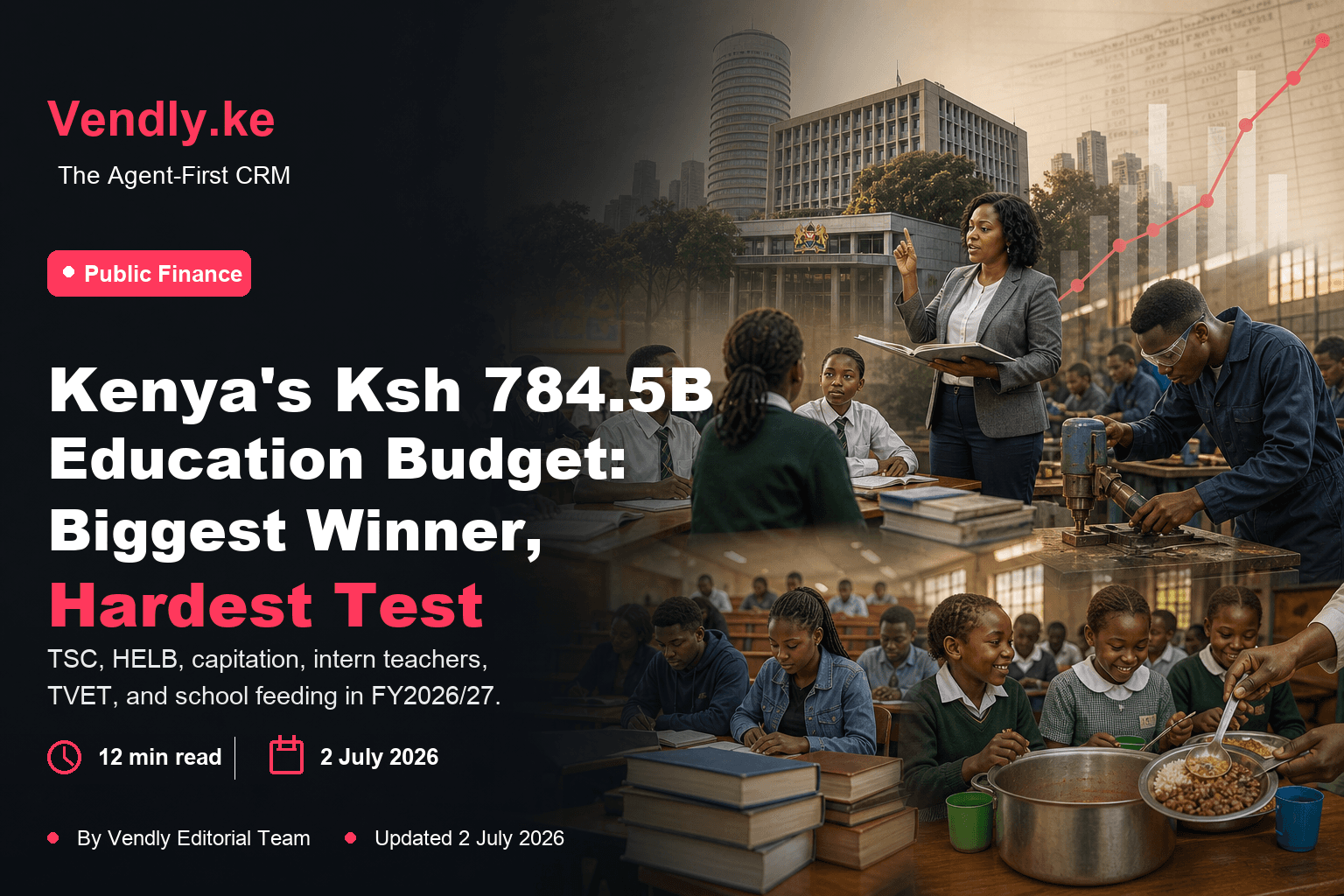
Education is the biggest winner in Kenya's FY2026/27 budget. The National Treasury's Mwananchi Guide puts the education allocation at Ksh 784.5 billion, equal to 26.8% of national government ministerial allocations.
That makes education larger than Energy, Infrastructure and ICT at Ksh 531.3 billion, more than four times health at Ksh 177.2 billion, and about seven times Agriculture, Rural and Urban Development at Ksh 111.7 billion. It is also very close to the entire ministerial development expenditure line of Ksh 809.0 billion.
In plain Kenyan budget language: education has won the allocation fight. The real test is whether that money reaches classrooms, teachers, learners, universities, TVET trainees, and school suppliers on time.
This is why the education budget should not be read like a victory lap only. It is a large number, but the pressure inside it is just as large. Teachers must be paid. Capitation must reach schools. Junior secondary must be supported. University students need loans and scholarships. TVET trainees need equipment and trainers. In poorer and arid areas, school feeding can be the difference between attendance and dropout.
For parents, this budget is not abstract. It lands in fee balances, boarding costs, lunch money, uniforms, textbooks, transport, remedial classes, and the constant question every household knows: if the government says education has been funded, why are schools still asking parents for more?
Where the Ksh 784.5B Goes
The headline allocation is large, but it is not one flexible pot of money. The largest part goes to the Teachers Service Commission. Other major lines support university and TVET students, free primary and day secondary education, junior secondary capitation, intern teachers, TVET development, school infrastructure, research, and school meals.
| Education item | FY2026/27 allocation | What it tells us |
|---|---|---|
| Total education allocation | Ksh 784.5 billion | The largest national government ministerial allocation |
| Teachers Service Commission | Ksh 408.5 billion | About 52% of the education budget is tied to teachers |
| HELB, scholarships, and university funding support | Ksh 96.4 billion | A major line for higher education access and the funding model |
| Free primary and free day secondary education | Ksh 61.6 billion | The capitation line most school heads watch closely |
| Junior secondary school capitation | Ksh 30.9 billion | Key support for the CBE transition in schools |
| Junior school intern teachers | Ksh 8.2 billion | Teacher support for a system still adjusting to junior school |
| TVET | Ksh 7.3 billion | Skills, trainers, equipment, and technical institutions |
| School feeding programme | Ksh 3.0 billion | A small line with a big effect in vulnerable households |
TSC Is the Centre of the Budget
The Teachers Service Commission allocation is the biggest story inside the education number. At Ksh 408.5 billion, TSC takes slightly more than half of the full education allocation. This makes sense because education is delivered through teachers. A classroom without a teacher is just a room with desks.
But it also means the education budget is very rigid. Salaries and related teacher costs cannot be paused like a new project. Once the payroll is due, it is due. That is good for teacher welfare and stability, but it reduces how much money remains for desks, labs, classrooms, digital devices, special needs support, textbooks, sanitation, boarding infrastructure, and school repairs.
This is the Kenyan education contradiction. Parents and teachers can both be right. Teachers can say staffing is still short, especially in junior secondary and hard-to-staff areas. Parents can also say schools lack resources despite the large allocation. A big TSC line does not automatically solve infrastructure, materials, or school operations.
Capitation Is Where Schools Feel the Budget
For headteachers and principals, capitation is where the budget becomes real. The FY2026/27 education allocation includes Ksh 61.6 billion for free primary and free day secondary education, plus Ksh 30.9 billion for junior secondary school capitation. These lines help schools pay for learning materials, operations, activity costs, maintenance, and other day-to-day needs.
The problem is that a capitation figure on budget day is not the same thing as cash in a school account. Timing matters. If money arrives late, schools still have to run. Suppliers want payment, food vendors want cash, support staff need wages, and students keep learning whether Treasury has released money or not.
The capitation test is simple: not just how much was allocated, but whether schools receive it early enough to avoid passing pressure back to parents and suppliers.
This is why parents often feel shortchanged. The government may have budgeted for free education, but a school facing late or inadequate cash may still ask for extra contributions, exam support, lunch money, boarding top-ups, activity fees, or infrastructure contributions. On paper, education is the winner. At the school gate, the story depends on disbursement.
Junior Secondary Is Still the Pressure Point
Junior secondary school remains one of the most important pressure points in the education system. The budget includes Ksh 30.9 billion for junior secondary capitation, Ksh 8.2 billion for junior school intern teachers, and Ksh 4.9 billion for the conversion of intern teachers into permanent and pensionable terms.
These lines matter because Kenya is still working through the transition from the old structure into competency-based education. Junior secondary requires teachers, learning materials, classrooms, laboratories, assessment systems, and leadership support. A school that was built around primary education cannot become a strong junior secondary school by changing the name on the gate.
For teachers, the intern and conversion lines touch morale directly. For parents, they affect classroom stability. For learners, they affect whether mathematics, science, languages, social studies, creative arts, and practical subjects are taught by people with enough preparation and support.
HELB and Scholarships: A Household Cash-Flow Issue
The Ksh 96.4 billion for HELB, scholarships, and related higher education support is one of the most politically sensitive parts of the education budget. University and TVET funding is not only a government issue. It is a household cash-flow issue.
When loans and scholarships delay, families scramble. A parent may delay rent, sell livestock, borrow from a chama, use mobile loans, pause business stock purchases, or ask an employer for a salary advance. The student feels it as hostel arrears, unpaid fees, missing course materials, transport stress, or lost study time.
The Education Sector Report shows why this line matters. It records that loans were awarded to 415,335 undergraduate students in FY2024/25, while TVET student loans reached 277,774. It also notes the shift around the new university funding and placement models, with some learners moving toward TVET institutions. In other words, this is not a small bursary issue. It is one of the main ways Kenya keeps post-secondary education open to households that cannot pay fees in one sitting.
TVET Is Small in Money, Big in the Jobs Debate
TVET receives Ksh 7.3 billion in the budget highlights. Compared with TSC or university funding, that looks small. But TVET is where the jobs discussion becomes practical. Kenya cannot talk seriously about manufacturing, construction, housing, automotive work, ICT, energy, agribusiness, and small enterprise productivity without technicians, artisans, trainers, and properly equipped institutions.
The Education Sector Report shows public TVET institutions have grown and enrolment has expanded sharply in recent years. That growth is useful only if training quality keeps up. A TVET centre without enough tools, trainers, workshops, internet, safety equipment, and industry links will not produce the skills employers need.
For Kenyan SMEs, this is where the education budget becomes a business story. A garage in Thika, a welding shop in Kisumu, a salon in Eldoret, a contractor in Kitengela, a hotel in Naivasha, or a small manufacturer in Ruiru needs people who can do the work. If TVET works, businesses spend less time retraining from scratch. If it does not, the skills gap becomes another hidden tax on productivity.
School Feeding Is Small, But It Carries Weight
The school feeding programme gets Ksh 3.0 billion. In a Ksh 784.5 billion education budget, that looks tiny. But for a child in a drought-hit area, an informal settlement, or a household where food is uncertain, a school meal can decide attendance.
The Education Sector Report says 2.6 million learners were fed in FY2024/25 under the School Meals Programme. That is the point: school feeding is not just a welfare line. It supports learning, attendance, concentration, and retention. A hungry child does not become a better learner because a budget speech says education is funded.
There is also a local business angle. School feeding can support farmers, millers, transporters, food suppliers, cooks, and local traders if procurement is clean and payments are timely. If payments delay, the same programme can hurt small suppliers who are expected to keep delivering while waiting for government cash.
Why the Big Winner Still Feels Stretched
Education is the biggest winner, but it is not free from the wider budget squeeze. The same budget carries Ksh 1.5013 trillion for interest payments, pensions, and related fixed obligations. That is almost twice the education allocation. Kenya is therefore trying to fund the future through education while paying heavily for past commitments.
This does not cancel the education win. It explains why even the winning sector can feel short. A ministry can receive the largest allocation and still face pressure if salaries take the biggest share, capitation is delayed, infrastructure needs are old, student funding demand keeps rising, and debt service is crowding the national budget.
| Pressure point | What parents or schools feel | Why it matters |
|---|---|---|
| Teacher payroll | More money goes to salaries before materials and infrastructure | Teachers are essential, but the budget becomes less flexible |
| Late capitation | Schools ask parents or suppliers to carry the gap | Free education feels less free at the household level |
| Higher education funding | Students wait for loans, scholarships, and fee support | Delays can push families into expensive borrowing |
| TVET quality | Institutions may grow faster than equipment and trainer capacity | Skills gaps affect jobs and SME productivity |
| School feeding | Small allocation with large attendance impact | Food insecurity can quietly become an education problem |
What Businesses Should Watch
Education is a public service, but it is also a large local economy. Around every school, college, and university are businesses: bookshops, cyber cafes, stationers, uniform makers, food vendors, transport operators, hostels, landlords, printers, furniture suppliers, cleaning firms, and private tutors.
When education money flows on time, those businesses feel it. When capitation delays, school suppliers carry receivables. When HELB delays, student towns feel lower spending. When parents face extra school demands, household consumption shifts away from other purchases. When schools delay paying food suppliers or contractors, small firms start financing government promises with their own cash.
This is why an SME near a school or college should not ignore the education budget. It affects payment cycles, demand seasons, stock planning, payroll timing, and credit risk. A supplier selling food, desks, textbooks, uniforms, lab equipment, stationery, or maintenance services should track signed LPOs, delivery notes, invoices, and receivables closely.
What to Watch During FY2026/27
The education allocation has already won the headline. The implementation story is what Kenyans should track month by month. A good education budget is not judged by the speech. It is judged by what happens in classrooms, lecture halls, workshops, laboratories, dormitories, kitchens, and school accounts.
- 1Capitation timing: Schools need predictable releases, not promises after suppliers have already delivered.
- 2Teacher placement: Junior secondary and hard-to-staff schools need teachers in the right subjects and locations.
- 3Intern teacher conversion: The conversion line should translate into stability, morale, and better classroom delivery.
- 4HELB and scholarship disbursement: Delays can push pressure from government to families and students.
- 5TVET equipment and trainer capacity: Enrolment growth must be matched by usable workshops and relevant skills.
- 6School feeding procurement: Timely payments matter for both learners and small food suppliers.
- 7Senior school transition: The next phase of CBE will test infrastructure, teacher preparedness, and subject pathways.
The Bottom Line
Education is the biggest winner in the FY2026/27 budget. That is good politics and good policy, because Kenya cannot build a stronger economy without better learning, stronger skills, and a fairer path from classroom to work.
But the Ksh 784.5 billion figure should be treated as a promise, not proof. The proof will be whether teachers are in class, capitation reaches schools on time, university and TVET students receive support without disruption, school meals keep vulnerable learners in class, and TVET produces skills that employers and small businesses can actually use.
For Kenyan households and SMEs, the lesson is practical. Watch the disbursements, not just the headline allocation. A winning budget line only becomes meaningful when it reduces the pressure at the school gate, in the lecture hall, at the TVET workshop, and in the business that supplies the education system.