Key takeaways
- The Comparison Kenyans Should Look At
- Why This Is a Services Story, Not Only a Debt Story
- Health: Ksh 177.2B Against an 8.5 Times Larger Obligation
- Agriculture: Food Security Competes With Old Bills
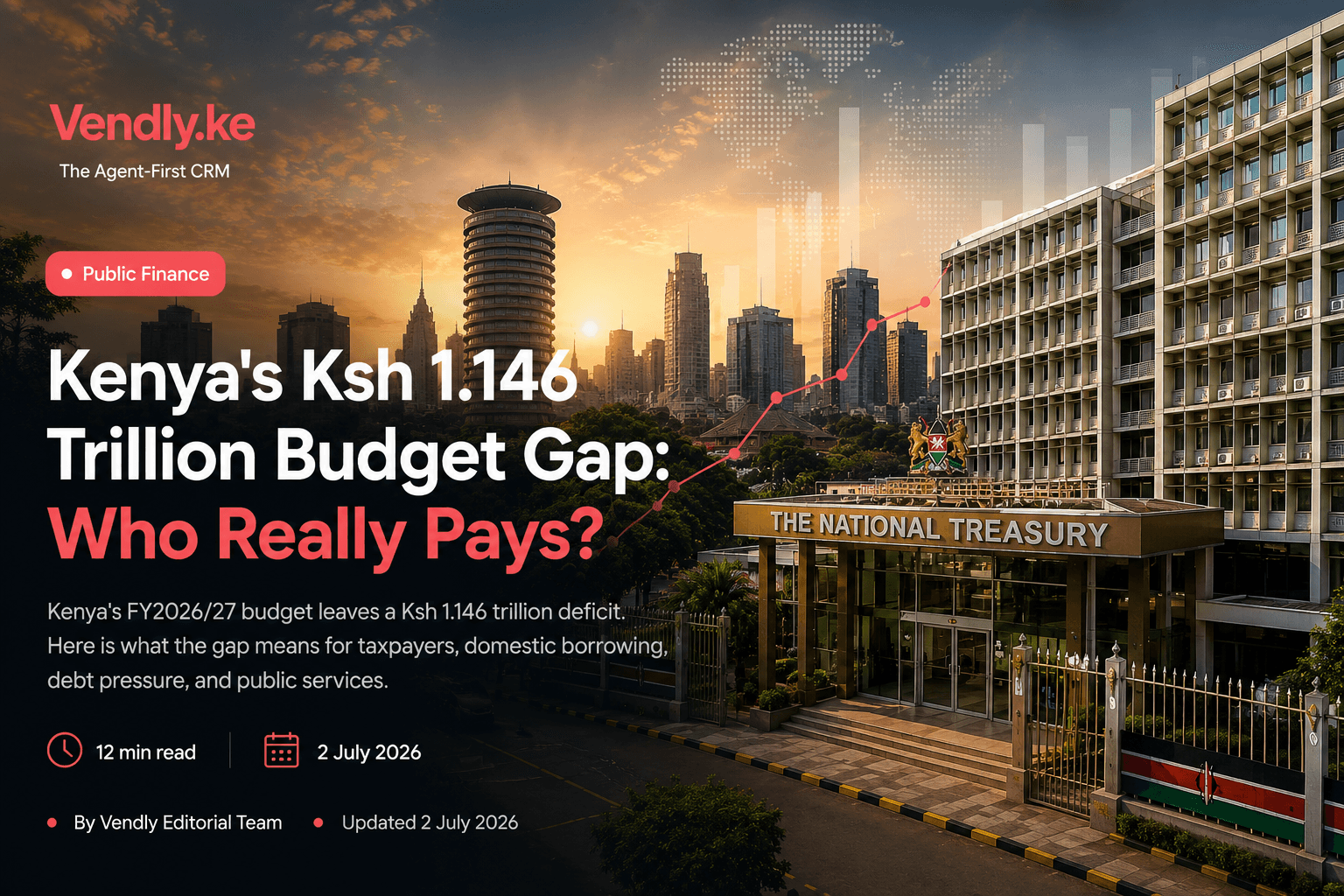
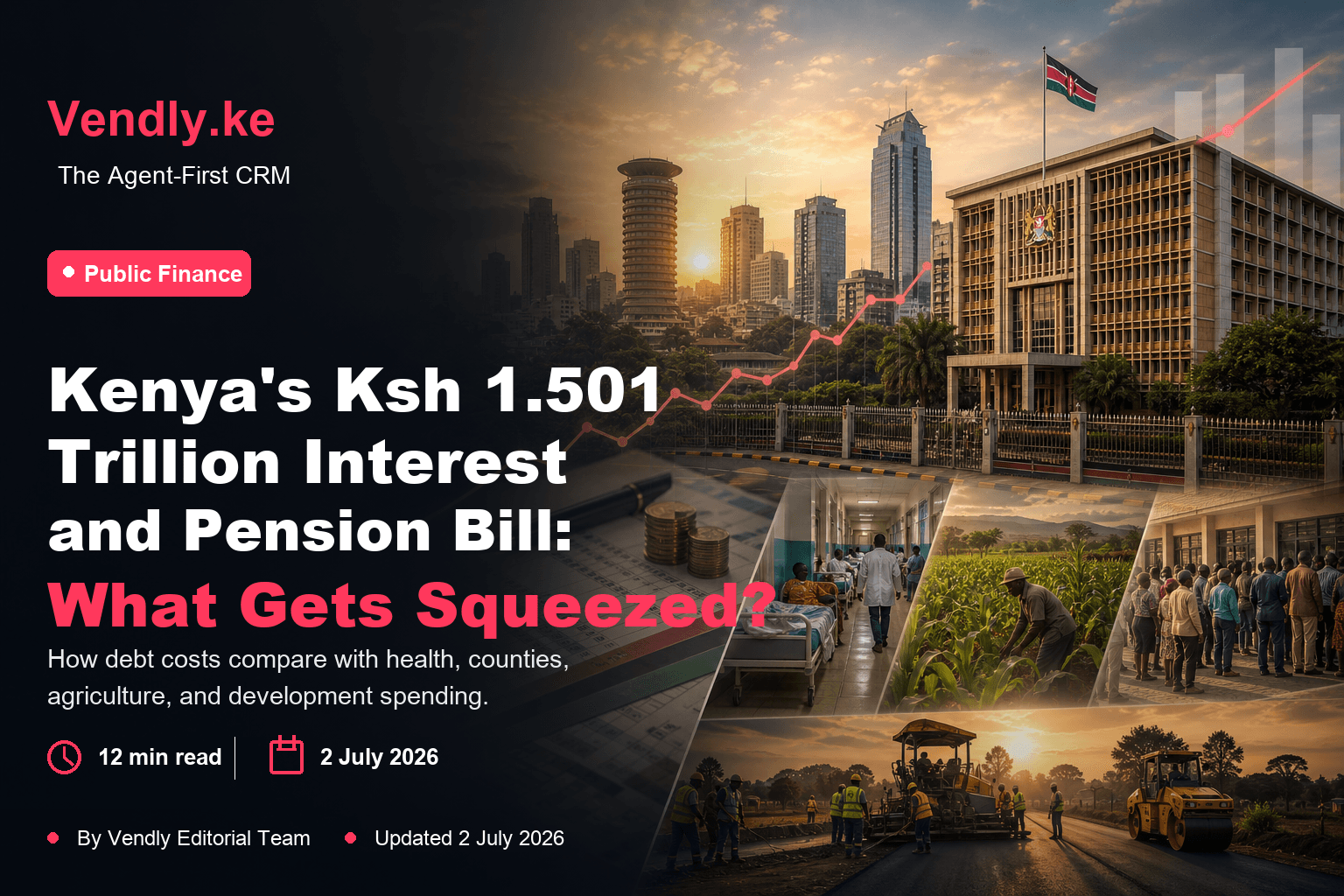
The sharpest number in Kenya's FY2026/27 budget is not only the Ksh 4.82 trillion spending plan. It is the Ksh 1.5013 trillion sitting under interest payments, pensions, and related Consolidated Fund Services obligations.
That single budget line is where old borrowing meets today's services. The Budget Summary says Consolidated Fund Services has been allocated Ksh 1.5013 trillion, made up of Ksh 986.7 billion for domestic interest, Ksh 267.5 billion for foreign interest, and Ksh 247.1 billion for pensions, salaries, and allowances. The Mwananchi Guide presents the same pressure in public language as interest payments, pensions, and net lending.
In simple terms, about Ksh 31 out of every Ksh 100 in the FY2026/27 spending plan is already spoken for before Kenyans start arguing about hospitals, fertilizer, roads, counties, or youth programmes.
This matters because Kenya's budget is not just a spreadsheet in Nairobi. It shows up in a county hospital trying to buy medicine, a farmer waiting for subsidized fertilizer, a contractor waiting for payment, a school depending on capitation, and an SME watching whether customers still have money after taxes, deductions, rent, and food.
Debt is not automatically bad. Kenya has borrowed to build roads, expand electricity connections, support rail and port infrastructure, respond to drought, and keep services running when revenue was short. The problem comes when the debt bill becomes so large that the government is paying heavily for yesterday's choices while today's needs keep growing.
The Comparison Kenyans Should Look At
The Ksh 1.5013 trillion line becomes clearer when placed next to the services people actually see. Health is allocated Ksh 177.2 billion in the Mwananchi Guide's public expenditure tracking. Agriculture, rural, and urban development is Ksh 111.7 billion. County shareable revenue is Ksh 428.0 billion. Ministerial development expenditure is Ksh 809.0 billion.
| Budget item | FY2026/27 allocation | How it compares with Ksh 1.5013T |
|---|---|---|
| Interest payments, pensions, and related CFS obligations | Ksh 1.5013 trillion | The fixed pressure point at the centre of the budget |
| Health | Ksh 177.2 billion | The CFS line is about 8.5 times bigger |
| Agriculture, rural, and urban development | Ksh 111.7 billion | The CFS line is about 13.4 times bigger |
| County shareable revenue | Ksh 428.0 billion | The CFS line is about 3.5 times bigger |
| Ministerial development expenditure | Ksh 809.0 billion | The CFS line is about 1.9 times bigger |
There is an important caution here. These categories are not all drawn from the same accounting bucket. Development spending overlaps with sector programmes, while county shareable revenue is part of intergovernmental financing. So the comparison is not a strict addition exercise. It is a pressure test: when a fixed obligation is bigger than health, agriculture, counties, and development spending taken one by one, the budget room for services is already narrow.
Why This Is a Services Story, Not Only a Debt Story
Many budget debates in Kenya start with new taxes, then move quickly to politics. But the quieter issue is what happens after money is collected. If a large share of revenue goes straight into interest and pensions, ministries and counties are left fighting over the remaining shilling. That is why a big budget can still feel tight at the dispensary, the ward office, the market, and the county roads department.
The Treasury language is 'fiscal consolidation' and 'debt sustainability'. On the ground, it is simpler. If the government pays more to service debt, it has less room to pay suppliers on time, less room to expand programmes, and less flexibility when drought, floods, fuel prices, a weak shilling, or court decisions change the numbers mid-year.
This is why Kenyans can hear that health has billions allocated and still walk into a facility where the basics are missing. The money is real, but the competition around it is also real. Health workers, vaccines, primary care, medical equipment, county hospitals, SHA transition costs, and referral hospitals all sit inside a budget where fixed national obligations are already heavy.
Health: Ksh 177.2B Against an 8.5 Times Larger Obligation
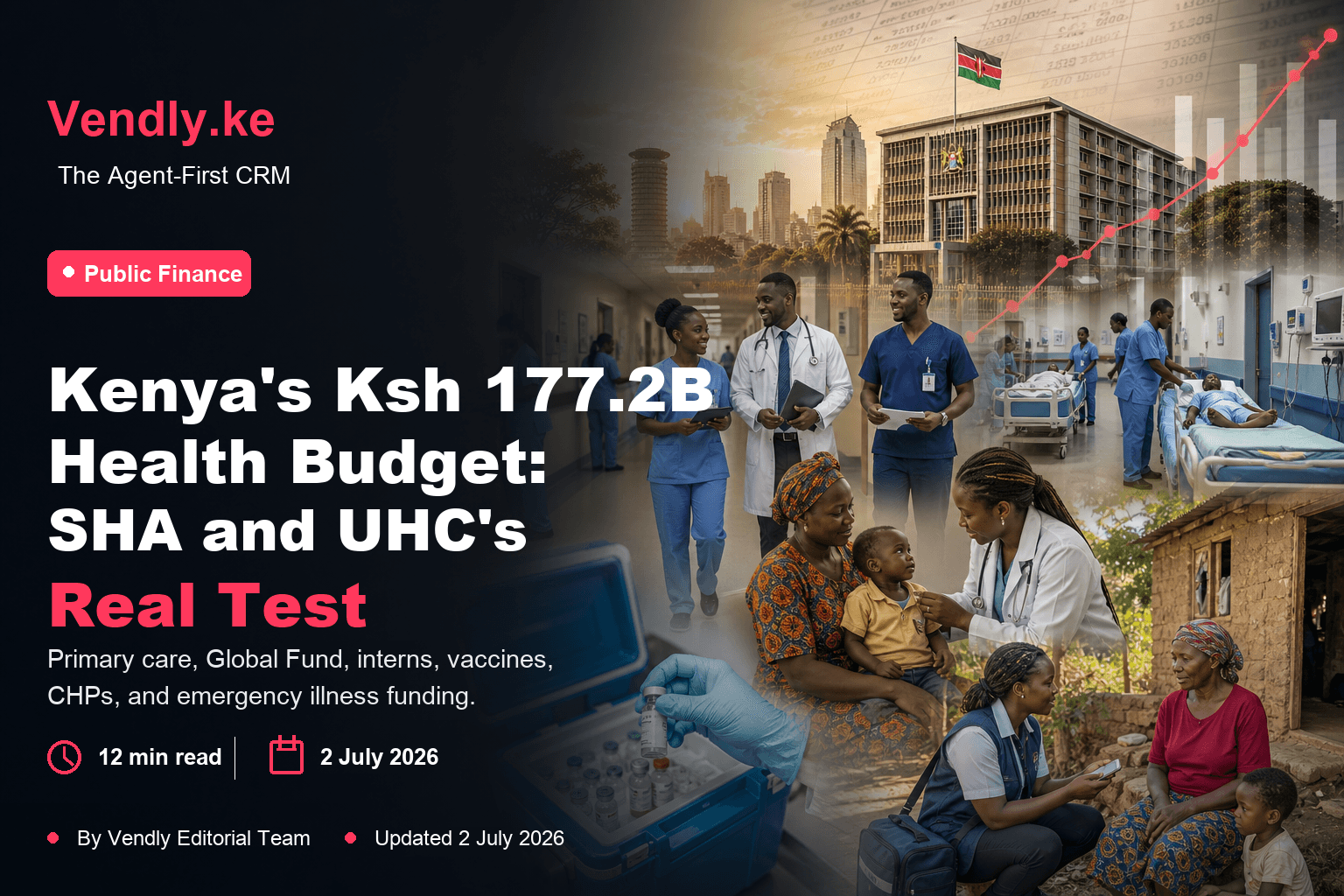
Health is one of the clearest examples because Kenyans feel it directly. The Mwananchi Guide lists health at Ksh 177.2 billion in public expenditure tracking. It also names several health allocations: Ksh 19.1 billion for the Primary Healthcare Fund, Ksh 18.5 billion through the Global Fund for HIV, malaria, and TB, Ksh 9.3 billion for health interns, Ksh 8.6 billion for Universal Health Coverage, Ksh 6.4 billion for vaccines, and Ksh 3.6 billion for Community Health Promoters.
Those are not small programmes. They touch households in every county. But the comparison is blunt: the Ksh 1.5013 trillion CFS line is about eight and a half times the public expenditure tracking figure for health. That does not mean debt is the only reason a hospital lacks supplies. Procurement, county management, fraud, late disbursements, human resource planning, and poor systems all matter. But debt service reduces the room available to fix those problems with money.
For an ordinary Kenyan, the question is not whether Treasury has a health line in the budget. It is whether the money arrives on time, whether it is enough for the promised services, and whether health facilities can convert allocations into medicine, staff, lab tests, referrals, and emergency care. A large fixed debt and pension bill makes that conversion harder.
Agriculture: Food Security Competes With Old Bills
Agriculture is politically popular because every government wants to talk about food prices. The FY2026/27 budget includes Ksh 18.0 billion for the Fertilizer Subsidy Programme, Ksh 5.4 billion for the Food Systems Resilience Project, Ksh 4.7 billion for the National Agricultural Value Chain Development Project, Ksh 3.3 billion for pastoral economies, Ksh 2.7 billion for sugar reforms, and Ksh 2.0 billion for seed subsidy.
But agriculture, rural, and urban development is shown at Ksh 111.7 billion in public expenditure tracking. The Ksh 1.5013 trillion CFS line is about 13.4 times bigger. That is the part many farmers do not see when they hear big budget speeches. Food security is being funded in the same budget that must pay domestic interest, foreign interest, and pension obligations first.
This matters for the price of unga, milk, vegetables, sugar, and animal feed. If agriculture programmes are late, too thin, or poorly executed, the effect lands in markets. A fertilizer subsidy delayed by a few weeks can miss a planting window. A livestock programme that underfunds extension services can leave pastoral counties exposed. A sugar reform line that does not translate into factory efficiency will not help the farmer waiting for cane payment.
When debt costs rise, the agriculture question becomes practical: are we funding enough production, storage, extension, irrigation, and market access to reduce future food pressure, or are we just announcing programmes that cannot carry the season?
Counties: Ksh 428B Looks Big Until You Compare It
Devolution is where many services touch citizens first. Counties handle county health facilities, agriculture extension, local roads, markets, trade licensing, water services in many areas, early childhood education, and local planning. The Mwananchi Guide says county governments are allocated Ksh 502.0 billion in FY2026/27, including Ksh 428.0 billion from equitable share, Ksh 16.6 billion in additional conditional allocations from the National Government share, and Ksh 57.4 billion in conditional allocations from development partners.
The equitable share is meaningful. But the Ksh 1.5013 trillion CFS line is still about 3.5 times the county shareable revenue figure. That comparison explains why county pressure can remain high even when the national budget appears large. If national resources are tight, county disbursements can be delayed, conditional funds can be slow, and counties can pass the stress to suppliers, health facilities, contractors, and staff.
Anyone who has supplied a county, worked on a local road project, or waited for a county hospital to clear bills understands this. A county budget can be approved, but cash timing is what determines whether services move. Delayed exchequer releases can turn a clean invoice into a six-month cash-flow problem for a small business.
Development Spending: The Investment Budget Is Smaller
Ministerial development expenditure is listed at Ksh 809.0 billion. This is where many future-facing commitments sit: roads, bridges, rail and port infrastructure, energy projects, water systems, health infrastructure, school infrastructure, digital projects, housing-related works, and other capital spending.
The CFS line is about 1.9 times bigger than ministerial development spending. That is a worrying signal because development spending is the part of the budget that should help the economy earn more tomorrow. It is not enough for Kenya to borrow. The country must turn public money into assets and services that make private work easier: cheaper transport, reliable power, better health, safer markets, faster internet, stronger skills, and more productive agriculture.
The Budget Summary itself acknowledges the pressure. It says development spending is projected at 29.0% of ministerial spending in FY2026/27, slightly below the 30% target, with the deviation reflecting rigid recurrent expenditures, particularly debt service and statutory obligations, as well as revenue underperformance.
The Hidden Business Cost for SMEs
For Kenyan SMEs, the debt and interest story is not abstract. It can affect sales, credit, tax pressure, and payment cycles. If government borrows heavily from the domestic market, banks, pension funds, insurers, and money market funds may keep more money in Treasury bills and bonds because the state is a safer borrower than a small trader, a restaurant, a garage, or a distributor.
That does not mean every business loan disappears. It means private borrowers compete against government paper. The effect can show up in loan pricing, collateral requirements, shorter repayment periods, tighter approvals, and less appetite for risk. A business that needs working capital to restock, finance an LPO, import raw materials, or bridge payroll may feel that pressure long before it reads a budget document.
There is also the tax side. A government with a large deficit and heavy debt service needs revenue. When new tax hikes are politically difficult, enforcement becomes the route. That means stronger eTIMS matching, cleaner VAT records, payroll compliance, bank and mobile money reconciliation, withholding tax discipline, and fewer gaps between what a business invoices, receives, and declares.
| Budget pressure | How it can reach a Kenyan SME | What to watch |
|---|---|---|
| High domestic interest bill | Government securities remain attractive to lenders | Loan rates, collateral demands, credit limits, and approval timelines |
| County cash pressure | Suppliers and contractors wait longer for payment | Receivables ageing, signed delivery notes, and payment follow-ups |
| Tax collection pressure | KRA relies more on data matching and compliance enforcement | eTIMS invoices, VAT returns, PAYE, withholding tax, and bank reconciliation |
| Squeezed services | Customers and workers spend more on private alternatives | Sales trends, salary advances, staff benefits, and customer payment behaviour |
What Good Debt Should Do
The fair test is not whether Kenya has debt. Almost every country borrows. The fair test is whether public debt leaves behind enough productivity to pay for itself. A road that lowers transport costs, a power line that reduces outages, a water project that supports farming, a port upgrade that speeds trade, or a health investment that keeps people working can justify borrowing better than money that disappears into stalled projects or routine operating gaps.
Kenyans should therefore ask a different question from the usual shouting match. Not just 'how much are we borrowing?' but 'what did the last borrowing make cheaper, faster, more reliable, or more productive?' If the answer is not visible in counties, markets, schools, hospitals, ports, roads, farms, and businesses, then the debt bill becomes harder to defend.
What to Watch in FY2026/27
The real budget story will not end with the Budget Speech. It will unfold in monthly revenue performance, domestic borrowing, county disbursements, pending bills, supplementary budgets, interest rates, and how quickly ministries execute development projects.
- 1Revenue performance: If ordinary revenue underperforms, the government may borrow more or delay spending.
- 2Domestic borrowing: More local borrowing can keep pressure on private-sector credit.
- 3County disbursement timing: Late releases can affect hospitals, suppliers, contractors, and local services.
- 4Development execution: Borrowed money is easier to defend when projects are completed and used.
- 5Pending bills: If unpaid bills keep growing, the pressure moves directly to businesses and workers.
- 6Interest-rate direction: Higher rates make the next budget harder before the year even starts.
The Bottom Line
Kenya's Ksh 1.5013 trillion interest, pension, and CFS obligation is not just a debt statistic. It is a measure of how much of the budget has already been claimed by past commitments. When that number is 8.5 times health, 13.4 times agriculture, 3.5 times county shareable revenue, and nearly twice ministerial development spending, the pressure on services is not theoretical.
The answer is not to pretend every borrowed shilling was wasted or every public project is useless. The answer is to demand a harder bargain: borrow less where spending is recurrent, borrow better where investment raises productivity, pay suppliers on time, clean up procurement, and make public money visible in services Kenyans can actually use.
For business owners, the practical response is to run tighter numbers. Keep cash-flow forecasts current, separate tax money early, reconcile bank and M-Pesa collections, monitor government receivables, and avoid building expansion plans on payments that are not yet in the bank. In a budget year where old obligations are taking a large share, businesses need to see pressure early and adjust before it becomes a crisis.