Key takeaways
- The Main Green Allocations
- Water Is the Biggest Practical Climate Item
- Why FLLoCA Matters
- Forests, Trees and Catchments
Kenya's climate and water allocations show how environmental policy has moved from conferences into household and business economics. Water access, flood control, waste management, forests, wildlife and county climate projects now affect farming, health, construction, tourism, energy and food prices.
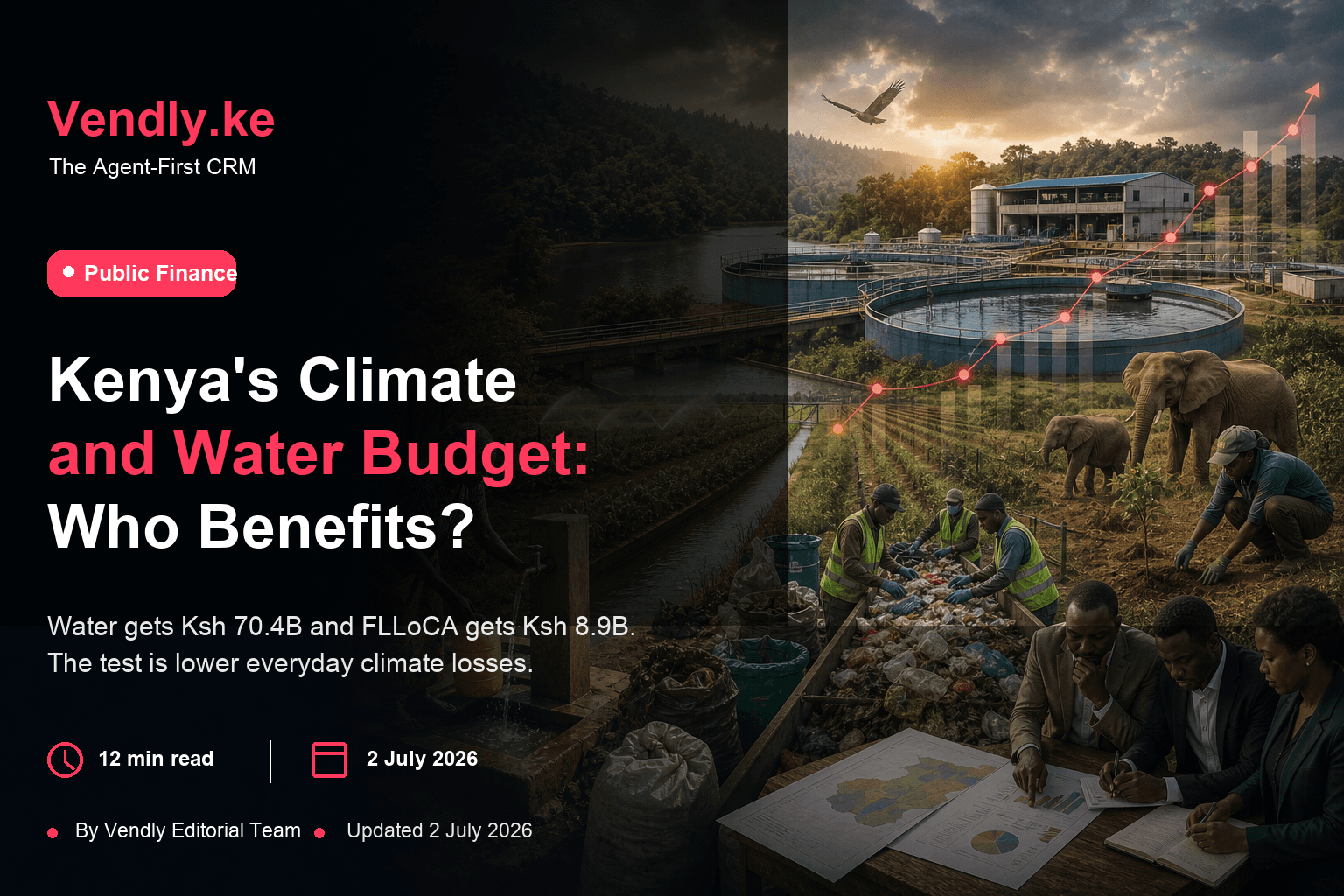
The Mwananchi Guide allocates Ksh 70.4 billion to expand access to clean and adequate water for domestic and agricultural use. It also allocates Ksh 8.9 billion to the Kenya Financing Locally Led Climate Action Project, widely known as FLLoCA.
Climate spending should be judged by whether it reduces everyday losses: dry taps, crop failure, flood damage, waste fires, livestock stress and unreliable local infrastructure.
The Main Green Allocations
| Area | FY2026/27 allocation | Why it matters |
|---|---|---|
| Clean and adequate water | Ksh 70.4B | Domestic supply, irrigation and agricultural productivity |
| Wildlife security and conservation | Ksh 15.1B | Tourism, biodiversity and human-wildlife conflict management |
| Forest conservation and management | Ksh 13.4B | Catchment protection and ecosystem resilience |
| FLLoCA | Ksh 8.9B | Locally led climate projects through county systems |
| Environment management and protection | Ksh 4.6B | Pollution control and regulatory capacity |
| Tree growing and rangeland restoration | Ksh 3.2B | Restoration, dryland resilience and carbon benefits |
| National solid waste management | Ksh 2.5B | Cleaner cities and waste-sector reform |
Water Is the Biggest Practical Climate Item
Ksh 70.4 billion for water is not just an environmental allocation. It is a health allocation, agriculture allocation and business productivity allocation. When water systems fail, households buy water expensively, hospitals struggle, schools suffer, farms lose output and businesses spend more on storage, trucking or boreholes.
For farmers, water determines planting decisions, livestock survival and yields. For urban businesses, water determines hygiene, food service, manufacturing, construction and customer experience. If water projects work, the return is felt far beyond the water ministry.
Why FLLoCA Matters
FLLoCA is important because climate damage is local. A flood-prone ward, a dryland grazing zone, a market with poor drainage, a riverbank settlement and a county road washed away by rain all need different responses. National climate speeches cannot design every local solution.
Locally led climate action can finance small but useful projects: water pans, drainage, ward-level resilience plans, rangeland restoration, early warning systems and community adaptation. The risk is implementation quality. If local climate money becomes another procurement line without maintenance, the impact will disappear after the first rainy season.
Forests, Trees and Catchments
Forest and tree-growing allocations should be read alongside water. Catchments determine river flows, soil retention and long-term water supply. Planting trees is easy to announce; maintaining seedlings, protecting catchments and preventing illegal logging is the harder work.
Kenya needs to measure survival rates, not only seedlings distributed. A tree campaign that reports planting but ignores survival is not climate resilience. Counties, schools, community groups and water agencies should publish simple survival and maintenance data.
Solid Waste Is a Business Issue
Ksh 2.5 billion for national solid waste management may sound smaller than water and forests, but waste affects city productivity. Poor waste systems block drainage, create health risks, raise cleaning costs, hurt tourism, damage informal settlements and reduce the value of markets and neighbourhoods.
The green economy opportunity is not only collection. It includes sorting, recycling, composting, waste-to-energy, circular manufacturing and formal jobs for waste workers. The budget should help counties move from dumping to value recovery.
Maintenance Is the Missing Climate Line
Water projects, drainage works, tree nurseries, waste facilities and climate-resilience assets all need maintenance. A borehole without a repair plan becomes a monument. A water pan without desilting loses capacity. A drainage system without cleaning becomes a flood channel. A seedling without aftercare becomes a number in a report.
Kenya's green budget should therefore report maintenance funding and operating responsibility. If a national project is handed to a county, the county must know who pays for repairs, staffing, electricity, security and community management. Climate resilience fails when ownership is unclear.
Businesses Already Pay for Climate Risk
For businesses, climate risk is not theoretical. Flooded roads delay deliveries. Water shortages raise production costs. Heat affects livestock and workers. Poor waste management blocks access to markets. Drought changes food prices and customer spending. Insurance and repairs add costs that rarely appear in ministry speeches.
That is why climate spending should be connected to economic planning. A county that protects markets from flooding, secures water for farming and manages waste properly is also protecting jobs and local tax revenue.
Water Governance Matters
Water allocations can disappear into projects that look complete but do not deliver reliable supply. Tariffs, water-user associations, county water companies, borehole management, metering, leak control and electricity costs all determine whether infrastructure keeps working. A new pipeline without governance can still leave households buying water from vendors.
The budget should therefore report functionality, not just construction. How many schemes are working six months later? How many farmers are irrigating? How many households moved from unsafe sources to reliable supply? Those are the numbers that matter.
The Green Economy Test
Kenya's climate spending should not be judged by the number of programmes alone. It should be judged by losses avoided and income created. Did water projects reduce tanker dependence? Did flood works protect markets? Did conservation protect tourism jobs? Did solid waste spending create cleaner cities and recycling value? Did FLLoCA projects survive beyond procurement?
That is the non-negotiable test. Climate money must leave behind working assets and lower risk, not only reports and launch photos.
Tourism also sits inside this budget. Wildlife security, conservation and forests protect livelihoods in conservancies, hotels, tour operations, crafts, transport and county revenue. When ecosystems fail, the losses move beyond wildlife into jobs and local businesses.
That is why green spending should sit in the economic debate, not on the side as a soft environmental topic.
The Bottom Line
The climate and water budget is really a cost-of-living, agriculture and productivity budget. Ksh 70.4 billion for water and Ksh 8.9 billion for locally led climate action can matter if projects are maintained, locally accountable and connected to real risks. If they are treated as ordinary procurement, Kenyans will still pay through water bills, flood losses, food prices and damaged livelihoods.