Key takeaways
- The Everyday Measures
- Bottled Water: Relief Depends on Pass-Through
- Sugar Drinks: Public Health Meets Household Cost
- Mitumba: Protecting a Livelihood Chain
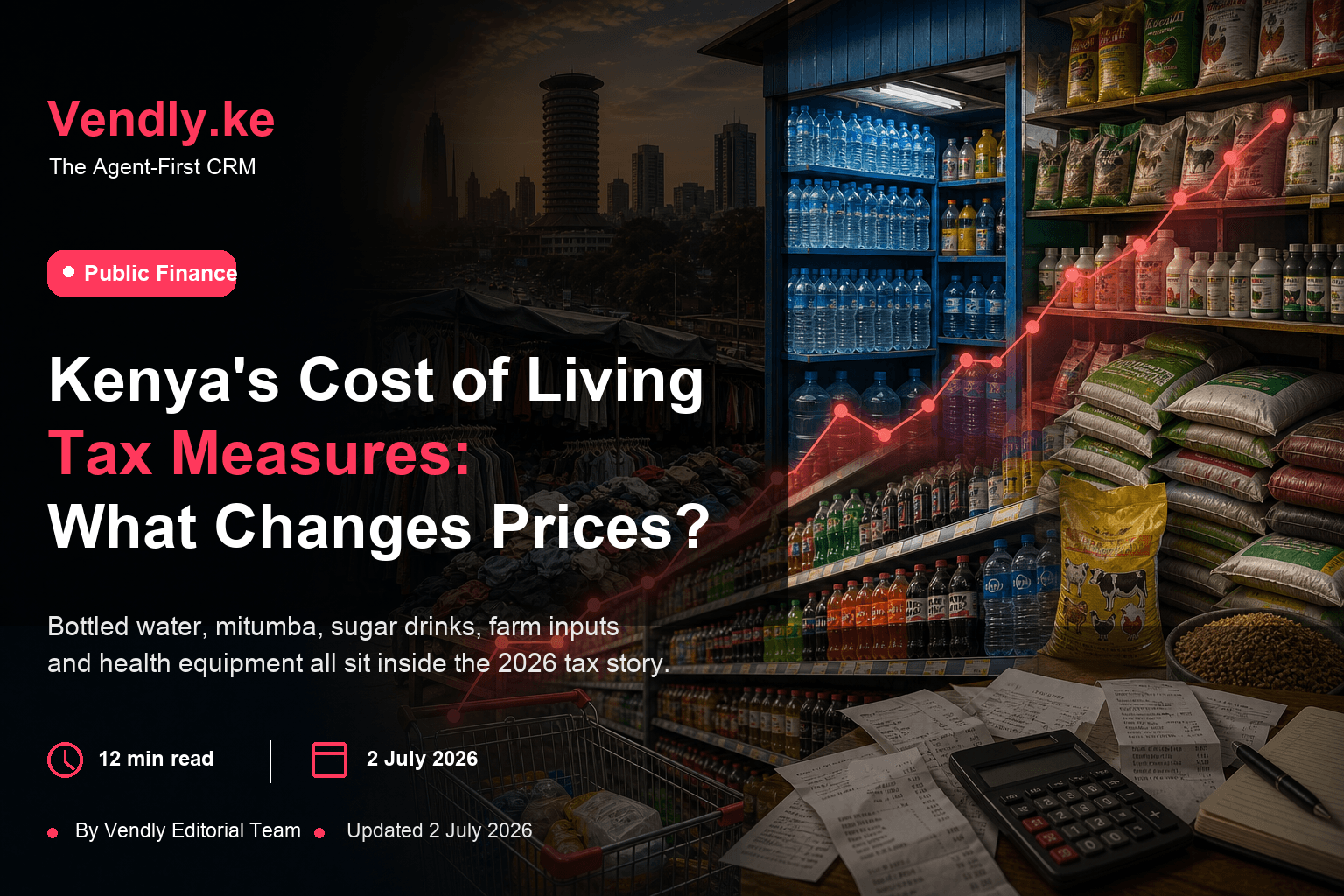
Cost of living is where budget policy stops being abstract. A tax line on bottled water, sugar drinks, mitumba, mobile phones, animal-feed inputs or dialysis equipment can show up at the kiosk, clinic, supermarket, school gate, farm shop and county market.
The 2026 tax package has both relief and pressure. It removes excise duty on bottled water, raises excise on sugar-sweetened beverages, keeps local mitumba sales outside VAT after importation, protects some health equipment relief, and after public pressure drops the proposed 25% mobile phone excise duty.
The cost-of-living test is not whether a tax measure sounds pro-consumer. It is whether prices actually fall or at least stop rising for the household paying the bill.
The Everyday Measures
| Measure | Budget or committee position | Likely household effect |
|---|---|---|
| Bottled water | Excise duty of Ksh 6.41 per litre removed | Prices may fall if vendors pass on the relief |
| Sugar-sweetened beverages | Excise proposed to rise from Ksh 14.14 to Ksh 20 per litre | Soft drinks and sweetened beverages may become more expensive |
| Mitumba | VAT at importation, local sales exempt | Traders avoid domestic VAT compliance; import cost remains |
| Dialyzers | VAT exemption for dialysis equipment component | Potential relief for kidney treatment costs |
| Mobile phones | 25% activation-based excise proposal deleted in committee report | Avoids a likely affordability shock for devices |
| Animal-feed inputs | Zero-rated status protected in committee report | Helps avoid higher feed and food-production costs |
| Solar and lithium batteries | Zero-rated status protected in committee report | Supports off-grid power affordability |
Bottled Water: Relief Depends on Pass-Through
Treasury proposed removing excise duty of Ksh 6.41 per litre on bottled water and said vendors were expected to pass the benefit to ordinary citizens through lower prices. That last part is the key. Tax relief does not automatically become a shelf-price cut.
Retail prices depend on competition, packaging costs, transport, distributor margins, shop rent and whether brands decide to keep part of the relief. Consumers should watch prices after implementation, not only the budget speech.
Sugar Drinks: Public Health Meets Household Cost
The proposed increase in excise on sugar-sweetened beverages from Ksh 14.14 to Ksh 20 per litre is framed as a public health measure. That argument is not new: governments use excise taxes to discourage products linked to health risks.
But households will experience it as a price increase if manufacturers and retailers pass it on. Small shops and wholesalers may also feel changes in demand. The health logic may be defensible, but the economic effect should be reported honestly.
Mitumba: Protecting a Livelihood Chain
Mitumba is not only second-hand clothing. It is a livelihood chain: importers, wholesalers, market traders, transporters, tailors, ironers, loaders and small retailers. Treasury's decision to charge VAT at importation while exempting local sales reduces compliance pressure on everyday traders.
That matters because requiring small mitumba sellers to manage VAT on every sale would be unrealistic and costly. Still, import-stage VAT affects bale cost. The practical relief is simpler trading, not necessarily cheap clothes overnight.
Health Equipment and Household Bills
VAT exemption for dialyzers is one of the more direct health-cost measures. Kidney patients need repeated dialysis, so equipment cost is not a one-off concern. Any relief should be tracked through hospital bills, supplier pricing and insurance claims.
This is where budget accountability matters. If the law lowers input costs but patients do not see any benefit, the relief has been captured somewhere in the chain.
Food and Farm Inputs
Food prices depend on many moving parts: rainfall, fuel, fertiliser, animal feed, logistics, storage and market power. The committee report's decision to protect zero-rated treatment for animal-feed inputs and sugarcane transport matters because input costs eventually reach the consumer through milk, meat, eggs, sugar and other food items.
The budget also includes agricultural spending such as fertilizer subsidy, seed subsidy and food resilience projects. Those programmes can help, but only if they reach farmers on time and are not eaten up by middlemen, delays or weak targeting.
The Mobile Phone Relief Is Also Cost of Living
Dropping the 25% mobile phone excise proposal belongs in the cost-of-living story because phones are now household infrastructure. A more expensive phone affects schoolwork, mobile money, job search, small business communication and access to government services.
Avoiding a price shock is not the same as lowering prices, but it protects digital access at a time when many services assume every Kenyan can transact through a device.
Small Businesses Need Price Evidence
For small businesses, these measures should not remain as policy rumours. Shops, clinics, restaurants, distributors and farmers should track supplier prices before and after implementation. If bottled water excise is removed but wholesale prices do not move, that is evidence. If animal-feed input relief protects prices, that is evidence too.
This matters because many businesses price from memory. In a volatile tax environment, proper purchase records help owners see whether margins are being squeezed by tax, supplier pricing, fuel, exchange rates or ordinary demand shifts.
Relief Can Be Captured in the Middle
A tax cut does not always reach the final buyer. Importers, manufacturers, wholesalers or retailers may keep part of the benefit if competition is weak or if other costs rise at the same time. That is why consumer-facing relief should be followed by price monitoring and competition scrutiny.
Household Pressure Is Cumulative
A family does not experience taxes line by line. It experiences the combined bill: rent, transport, school costs, food, airtime, electricity, water, health and debt repayments. A small relief on one item can be wiped out by a price increase on another. That is why the cost-of-living discussion should look at the household basket, not isolated wins.
The same is true for small businesses. A shop may benefit from cheaper bottled water stock but pay more for transport, packaging, bank fees or soft drinks. Owners need to watch total margin, not just one tax headline.
The Bottom Line
Kenya's cost-of-living measures are mixed. Bottled water and health equipment relief can help if passed through. Sugar drinks may cost more. Mitumba traders get simpler VAT treatment but not a full import-cost removal. Food-input relief protects consumers indirectly. The honest way to judge the package is by prices at the shop, clinic, market and farm input supplier after the headlines fade.