Key takeaways
- The County Funding Mix
- Why the Equitable Share Matters Most
- Health Is the County Pressure Point
- Agriculture and Roads Are Also Local
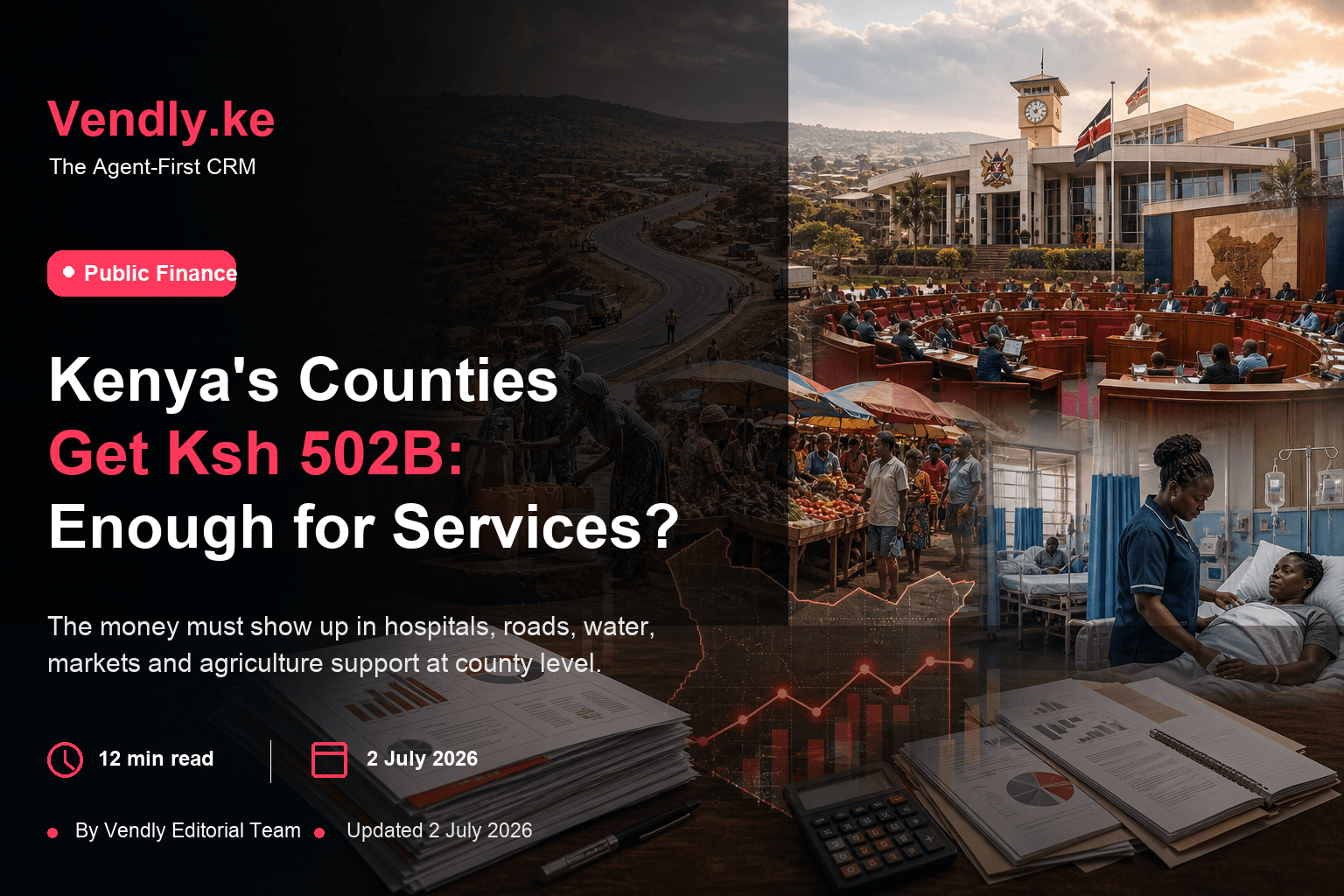
County governments are allocated Ksh 502.0 billion in FY2026/27. On paper, that is a major devolution number. In practice, every county resident knows the real question: will it keep hospitals supplied, roads passable, water flowing, markets working and agriculture supported?
The Mwananchi Guide breaks the total into Ksh 428.0 billion equitable share, Ksh 16.6 billion additional conditional allocations from the national government share of revenue, and Ksh 57.4 billion conditional allocations from development partners.
Devolution funding should be judged at the dispensary, market, ward road, water point and county payment desk, not only in the national budget table.
The County Funding Mix
| County funding component | FY2026/27 amount | What it means |
|---|---|---|
| Equitable share | Ksh 428.0B | Main unconditional transfer shared among counties |
| National conditional allocations | Ksh 16.6B | Targeted funds tied to specific national priorities |
| Development partner conditional allocations | Ksh 57.4B | Donor-supported programmes channelled through counties |
| Total county allocation | Ksh 502.0B | Total support to county governments in the budget |
Why the Equitable Share Matters Most
The equitable share is the most important part because counties have more flexibility over it. It pays salaries, operations, essential services and local priorities. The guide says the Ksh 428.0 billion equitable share is equivalent to 21.0% of actual revenue raised nationally in FY2022/23.
But flexibility does not mean comfort. Counties carry wage bills, health demands, pending bills, fuel costs, drug procurement, ECDE support, agriculture extension, roads, water and administrative costs. A county can receive a large headline allocation and still struggle if salaries and inherited obligations swallow development money.
Health Is the County Pressure Point
Healthcare is devolved in ways ordinary Kenyans feel directly. County hospitals, sub-county hospitals, dispensaries, nurses, clinical officers, drugs, ambulances and facility operations all depend heavily on county execution. National health allocations can support SHA, vaccines and UHC programmes, but a patient still meets the county system first.
That is why county cash flow matters. If Exchequer releases delay, hospitals run short, suppliers wait, and facilities start asking patients to buy basics outside. The budget number may be national, but the frustration is local.
Agriculture and Roads Are Also Local
Agriculture is another area where national policy and county delivery meet. Fertilizer subsidies and national food-security programmes are important, but extension officers, livestock services, local markets, feeder roads and county abattoirs determine whether farmers actually benefit.
The same applies to roads. National highways are visible, but small businesses depend on estate roads, feeder roads, market roads and rural access roads. A farmer can lose value because the last ten kilometres are impossible in the rainy season.
Conditional Money Is Useful, But Restricted
Conditional allocations can help fund health, water, climate or donor-backed programmes, but they are restricted. A county cannot always move that money to its most urgent pressure. That is why the split between equitable and conditional funding matters.
Development partner money can also come with reporting requirements, procurement conditions and project timelines. Those safeguards can improve accountability, but they can also slow implementation if county capacity is weak.
Timing Can Matter More Than the Total
County budgets often fail residents not because the approved number is zero, but because cash arrives late. A county can pass a budget, award tenders, hire staff and plan services, then still struggle if Exchequer releases delay. Suppliers extend credit, hospitals ration purchases and small contractors wait months for payment.
This is why residents should ask about quarterly releases, not only annual allocation. If money arrives in the last quarter, counties rush procurement or push projects into pending bills. Service delivery needs predictable cash flow across the year.
County Procurement Is an SME Issue
County governments are major customers for small businesses: stationery suppliers, clinics, food vendors, road contractors, cleaning firms, transporters, construction suppliers, borehole service providers and professional firms. When counties delay payment, the pain lands in local business cash flow.
A stronger devolution system would publish procurement plans, contract awards, payment status and pending bills in a way businesses can trust. That would reduce rumours, improve competition and make county business less dependent on who knows whom.
A Citizen Scorecard for Devolution
Residents do not need to wait for complex audit reports to judge devolution. A practical scorecard can ask whether the nearest health facility has medicine, whether local roads are graded before rains, whether water projects work after commissioning, whether ECDE centres have support, and whether traders can pay county fees through clear digital channels.
That kind of scorecard makes the Ksh 502.0 billion real. It shifts the conversation from governor speeches to ward-level evidence.
The Own-Source Revenue Question
Counties cannot rely only on transfers. Own-source revenue from rates, parking, markets, permits, cess and service charges should help fund local services. But the collection system must be fair and predictable. If counties squeeze traders with many small fees while services remain poor, businesses see devolution as a cost rather than support.
Good county revenue reform should digitise collection, reduce leakages, publish collections and connect fees to visible service delivery. A trader is more willing to pay when the market is clean, secure, lit and accessible.
What Residents Should Watch
- 1How much of the county budget goes to salaries versus development.
- 2Whether hospitals receive drugs and pay suppliers on time.
- 3Whether pending bills are disclosed and reduced.
- 4Whether ward-level projects match public participation priorities.
- 5Whether own-source revenue increases come with better services.
- 6Whether conditional donor projects are completed and maintained after funding ends.
The counties that will perform best are not necessarily the ones with the biggest allocations. They are the ones that control wage pressure, pay suppliers predictably, protect development money, digitise revenue without harassing traders, and maintain projects after commissioning.
That is the practical meaning of devolution: not offices closer to people, but decisions, money and accountability closer to the services people use.
The Bottom Line
Ksh 502.0 billion for counties is significant, but adequacy depends on timing, wage pressure, pending bills, local revenue and execution. Devolution succeeds when the money changes daily services: a working dispensary, a graded road, clean water, functioning markets and agriculture support that reaches farmers. Anything less will feel like another national number that never arrived in the ward.