Key takeaways
- Where the Manufacturing Money Goes
- SEZs Need More Than Tax Incentives
- Agro-Industrial Parks and County Value Addition
- Coffee Relief Must Reach Farmers
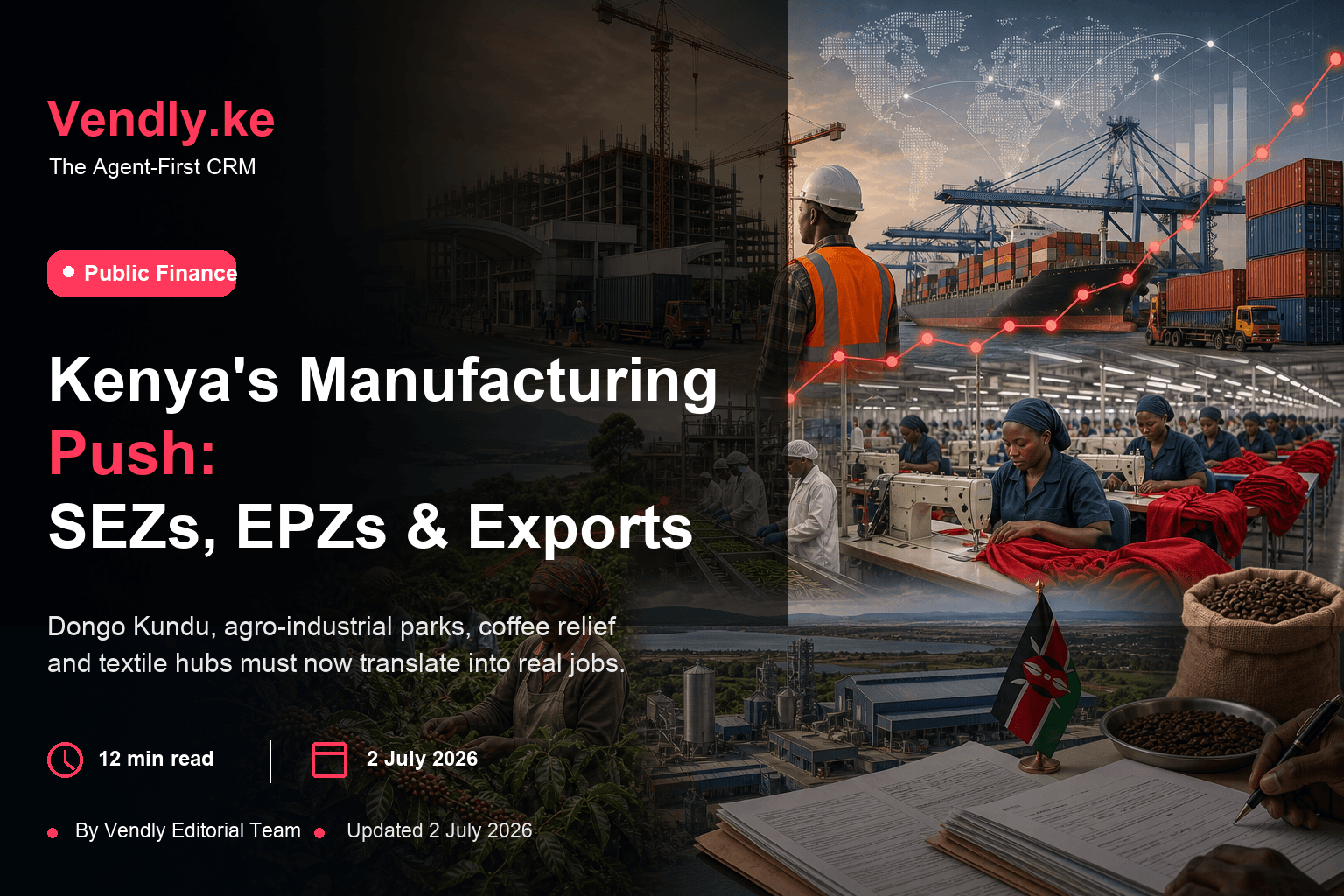
Kenya's manufacturing budget is a jobs story, an exports story and a county value-addition story. The Mwananchi Guide says Ksh 16.7 billion has been allocated through various ministries and agencies to support industrial growth and local manufacturing in FY2026/27.
The allocations point to a clear strategy: build special economic zones, support agro-industrial parks, revive textiles, reduce coffee-sector stress and use incentives to attract larger capital investments. The challenge is turning zones and hubs into actual production, exports and decent jobs.
Manufacturing policy should be judged by factory output, export orders, supplier payments and jobs, not only by serviced land and launch ceremonies.
Where the Manufacturing Money Goes
| Programme or project | FY2026/27 allocation | Policy angle |
|---|---|---|
| Dongo Kundu Special Economic Zone | Ksh 4.2B | Coastal industrial and export platform |
| County Integrated Agro-Industrial Parks | Ksh 2.6B | County value addition and farmer-market linkages |
| Coffee debt waiver and Coffee Cherry Revolving Fund | Ksh 2.5B | Coffee-sector balance sheet relief and liquidity |
| Coffee seedlings and revitalisation | Ksh 1.1B | Productivity and sector renewal |
| Flagship EPZ hubs and Athi River Textile Hub | Ksh 902M | Apparel, exports and industrial jobs |
| SEZ Textile Park Naivasha | Ksh 604M | Textile manufacturing and export positioning |
SEZs Need More Than Tax Incentives
Special Economic Zones can attract investors when they offer reliable power, water, customs efficiency, logistics, land readiness and predictable tax treatment. But tax incentives alone cannot carry a weak operating environment. A manufacturer cares about total delivered cost, not only the headline corporate tax benefit.
Dongo Kundu's promise is location. A coastal SEZ can connect port logistics, regional trade and export processing. The public should watch whether it attracts producers, not only warehouses and land speculation.
Agro-Industrial Parks and County Value Addition
County Integrated Agro-Industrial Parks are meant to move counties beyond raw produce sales. The idea is simple: process closer to farmers, reduce post-harvest losses, create county jobs and build supply chains around local crops, livestock and fisheries.
The risk is duplication. Every county cannot build a successful industrial park by copying the same plan. Parks need products, power, water, cold storage, buyers, skilled workers, roads and private operators. Without demand, they become buildings looking for business.
Coffee Relief Must Reach Farmers
Coffee debt relief and the Coffee Cherry Revolving Fund are important because farmer liquidity shapes production. If farmers wait too long for payment or carry debt from weak cooperative systems, coffee quality and output suffer. Debt relief can create breathing room, but it should not hide governance failures.
A stronger coffee intervention should show faster farmer payments, better factory governance, transparent deductions, improved seedlings, stable extension support and access to better markets. The budget line must become cash and confidence at farm level.
Textiles, EPZs and Export Jobs
Textile hubs in Athi River and Naivasha sit inside Kenya's export-jobs ambition. Apparel can employ many people, especially young workers, if orders are consistent and factories can operate competitively. But the sector is sensitive to energy costs, compliance standards, labour productivity, logistics and global buyer decisions.
Kenya should avoid treating EPZs as isolated islands. The stronger model is to build local supplier links: packaging, transport, food services, maintenance, payroll services, accounting, security and local raw materials where possible. That is how export zones spread income beyond the factory gate.
Power, Customs and Skills Decide Competitiveness
A factory does not become competitive because a zone exists on a map. It needs reliable power, predictable tariffs, fast customs clearance, efficient port handling, skilled workers, water, security and transport links. If one of those fails, the investor prices the risk into wages, output, margins or relocation decisions.
Kenya's manufacturing policy therefore has to join up ministries that often work separately. Industrial parks need roads. Export firms need customs. Textile factories need training. Agro-processors need farmers, cold chains and standards. Tax incentives cannot compensate for weak basics forever.
Incentives Need Conditions
Tax incentives for large capital investments can be useful, but they should not be blank cheques. The public should know what the country receives in exchange: minimum investment, jobs, exports, local procurement, technology transfer, training, environmental compliance and timelines.
If incentives are given without performance reporting, Kenya risks subsidising capital that would have invested anyway, or rewarding firms that hold land and wait. A good incentive regime publishes outcomes without exposing legitimate commercial secrets.
The SME Supplier Opportunity
Manufacturing zones can help SMEs if procurement is deliberately opened up. A garment factory buys meals, transport, repairs, packaging, cleaning, accounting, security and spare parts. An agro-processor buys crates, logistics, cold storage services and farm inputs. Those links can create local businesses around the anchor investor.
For that to happen, SMEs need information, quality standards, payment discipline and financing. Otherwise the big investor arrives, but local firms remain outside the gate.
Exports Need Market Access
Manufacturing policy also depends on markets. An export factory needs predictable access to buyers, trade preferences, standards compliance and shipment reliability. If global buyers worry about delays, labour compliance, policy instability or port costs, they place orders elsewhere even when Kenya offers incentives.
That is why the budget should be connected to trade diplomacy, standards agencies and customs reform. The factory floor is only one part of the export chain. The order book is built through confidence.
What Success Should Look Like
- 1New factories producing and exporting, not only investors signing memoranda.
- 2More local suppliers selling into SEZ and EPZ supply chains.
- 3Faster farmer payments in coffee and agro-processing value chains.
- 4County parks with anchor buyers and product focus.
- 5Transparent reporting on jobs created, wages, exports and local procurement.
- 6Tax incentives linked to real investment and performance, not passive asset holding.
Import substitution should also be treated carefully. Kenya should make more locally where it is competitive, but protection without productivity can leave consumers paying higher prices. The stronger path is to help firms upgrade quality, reduce costs and sell both at home and abroad.
That requires patient execution. Industrial policy does not fail only because the idea is wrong; it often fails because the boring operational details are left unfunded or unmanaged.
The budget must therefore buy capability, not just buildings.
The Bottom Line
Kenya's manufacturing push has the right themes: exports, agro-processing, textiles, SEZs and farmer-linked value addition. The danger is mistaking infrastructure and incentives for industrialisation. Manufacturing grows when firms can produce competitively, sell reliably and pay workers consistently. The 2026 budget should be judged by output, orders and jobs.