
Key takeaways
- What Treasury Proposed
- Why the Pushback Was Strong
- Why Local Assembly Was Part of the Argument
- What Parliament Changed
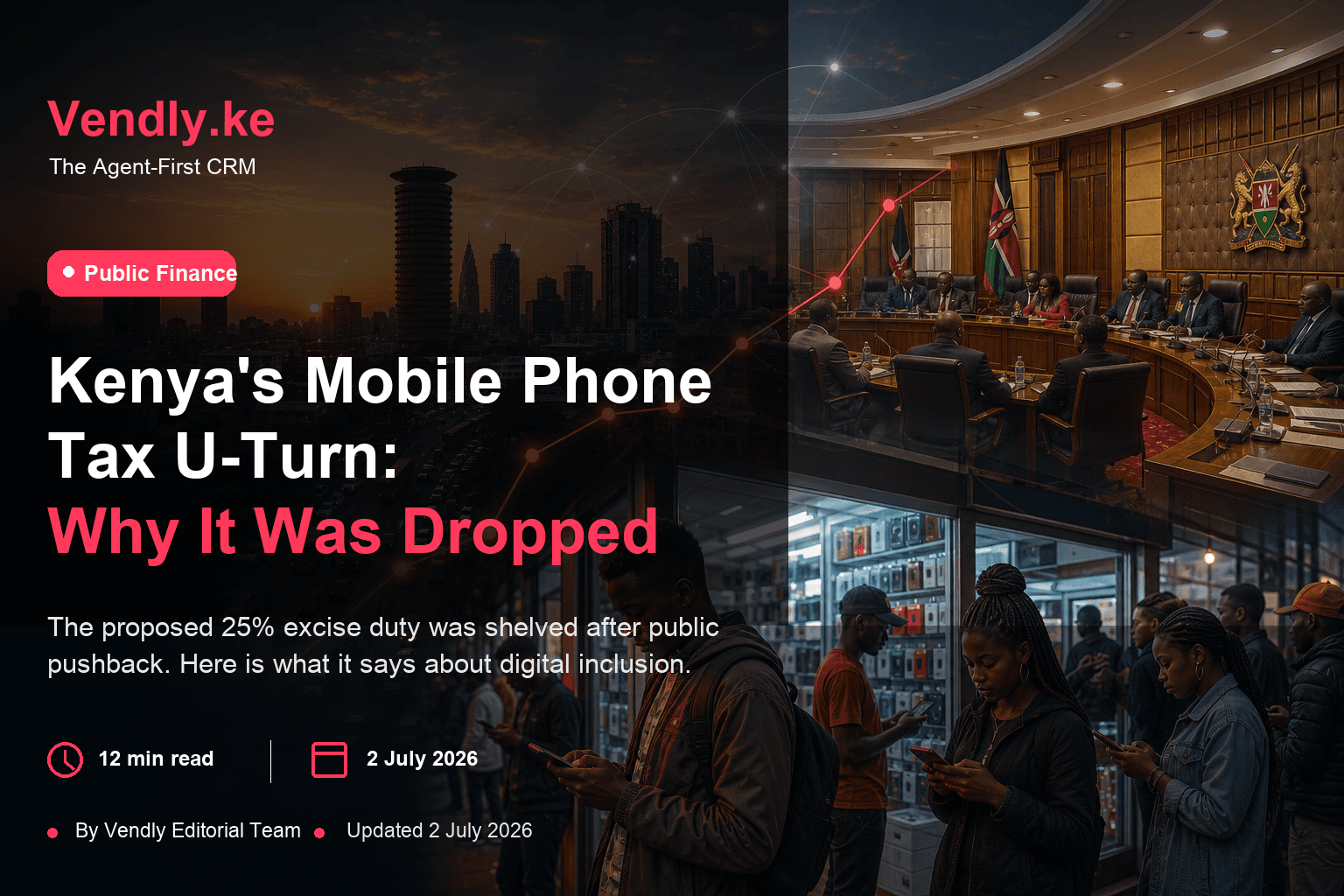
The proposed 25% excise duty on mobile phones became one of the clearest public-participation stories in Kenya's 2026 tax debate. Treasury framed it as a simplification measure. Many Kenyans heard something different: phones would become more expensive in a country where the phone is already the bank branch, classroom, job board, shopfront, till number and government-service desk.
In the Budget Statement, Treasury argued that mobile phones are essential for communication, business, education, healthcare, e-commerce and financial services. The same speech then proposed replacing several existing taxes and levies with a single 25% excise duty charged at the point of activation on a Kenyan telecommunications network.
The politics of the mobile phone tax were simple: if the phone is now basic infrastructure, taxing it like a luxury product becomes hard to defend.
What Treasury Proposed
Treasury's argument was that the proposal would simplify the tax structure around mobile phones. Instead of multiple taxes and levies at importation or other points in the chain, the tax would be charged as excise at activation. In theory, this could make the import and retail chain cleaner.
But activation is where the policy ran into real life. Phones move through importers, assemblers, distributors, repair shops, second-hand markets, gifts, device swaps, insurance replacements and informal resellers. A tax charged when a phone first connects to a network would require telecoms, importers, dealers and KRA to agree on device identity, tax status, exemptions, liability and timing.
| Policy point | Treasury's case | Public concern |
|---|---|---|
| Tax rate | Single 25% excise duty at activation | Likely higher retail cost for many buyers |
| Tax point | Activation on a Kenyan network | Hard to administer and confusing for consumers |
| Digital policy | Simpler tax system for phones | Could undermine digital inclusion |
| Local assembly | A clearer regime | Risk of hurting local manufacturers and low-cost devices |
Why the Pushback Was Strong
Stakeholders told Parliament that mobile phones are no longer optional. Students need them for learning, job seekers need them for applications, farmers use them for weather and market information, traders use them for payments, and households use them for banking, insurance, health and government services.
The committee report records repeated concerns that the proposal would hurt low-income households, students, rural users, first-time internet users and young people. That is the Kenyan reality: the cheapest smartphone is often the first step into digital work, online learning, mobile money, tax services and customer communication.
Why Local Assembly Was Part of the Argument
The Finance Bill debate also touched local manufacturing. Kenya has been trying to support local assembly of mobile phones and digital devices. If the tax structure makes locally assembled phones less competitive or less affordable, it works against that industrial policy.
This is why some stakeholders preferred a differentiated approach: lower or zero duty for entry-level devices, modest rates for mid-range phones and higher rates for premium devices. That approach tries to protect digital access while still allowing the government to raise revenue from higher-value consumption.
What Parliament Changed
Parliament's committee recommended deleting the proposal to shift mobile phone excise duty to activation. The report says the change would create compliance challenges, delay revenue collection and create uncertainty for consumers. It also says further policy review and stakeholder consultation would be needed before such a system could work.
That is the important accountability point. Public participation did not only produce complaints. It changed the policy direction. For a tax measure that would touch nearly every Kenyan household and small business, that is exactly where public participation should matter.
The Second-Hand Phone Market
One weakness in activation-based taxation is the second-hand market. Kenya has a large used-phone economy: hand-me-down phones, refurbished imports, repair-shop resales, corporate disposals and phones bought abroad by relatives. A clean tax system has to know whether a phone is new, already taxed, locally assembled, imported as used, repaired after damage or being activated by a second owner.
If that system is not clear, consumers may be asked for proof they do not have, dealers may hold stock they cannot price confidently, and telecom operators may become tax gatekeepers for transactions they did not sell. That is why the committee's concern about consumer uncertainty was not minor. It goes to the practical heart of the proposal.
The Business Angle
For businesses, mobile phone affordability is not a consumer-only issue. A phone is a sales device, payment device, delivery device, customer-service channel and recordkeeping tool. A higher device cost affects riders, sales reps, fundis, shop attendants, agents, field officers, small online sellers and county-level service businesses.
If entry-level devices become expensive, small firms delay upgrades, employees share devices, customers remain offline and digital services grow more slowly. That reduces the tax base in the long run because digital activity creates records. KRA can see mobile payments, invoices, online sales and formal settlements more easily than cash transactions.
What a Better Phone Tax Debate Needs
Before returning with a similar measure, Treasury should publish a proper price-impact model. Kenyans need to see how an entry-level smartphone, feature phone, locally assembled device, imported finished phone and refurbished phone would be affected. The model should include VAT, excise, customs charges, dealer margins and the proposed timing of tax payment.
KRA and the Communications Authority would also need a clean device-identification and dispute process. If a phone is wrongly flagged as taxable, the consumer should not be left moving between the dealer, mobile operator and KRA counter. A digital policy that creates queues, uncertainty and blocked activations is not digital inclusion.
The Lesson for Future Tax Policy
The lesson is not that mobile phones should never be taxed. The lesson is that digital-inclusion taxes need careful design. Kenya can tax premium consumption, protect local manufacturing, keep low-cost devices accessible and still improve revenue if the tax is predictable, simple and aligned with national digital policy.
A good future framework would publish the expected price impact, separate basic devices from premium devices, protect locally assembled entry-level phones, define the tax point clearly and give the industry enough time to adjust systems. Without that, a phone tax will always look like a tax on participation in the modern economy.
The Bottom Line
The dropped mobile phone tax shows that public participation can still move policy when the issue is concrete and widely understood. Kenyans did not need a tax textbook to understand this one. If the phone is where school, work, banking, business and government services now happen, making it less affordable is not a small tax change. It is a digital inclusion decision.