Key takeaways
- What the Amnesty Covers
- Why Government Likes Amnesty
- The Moral Hazard Problem
- The New KRA Enforcement Environment
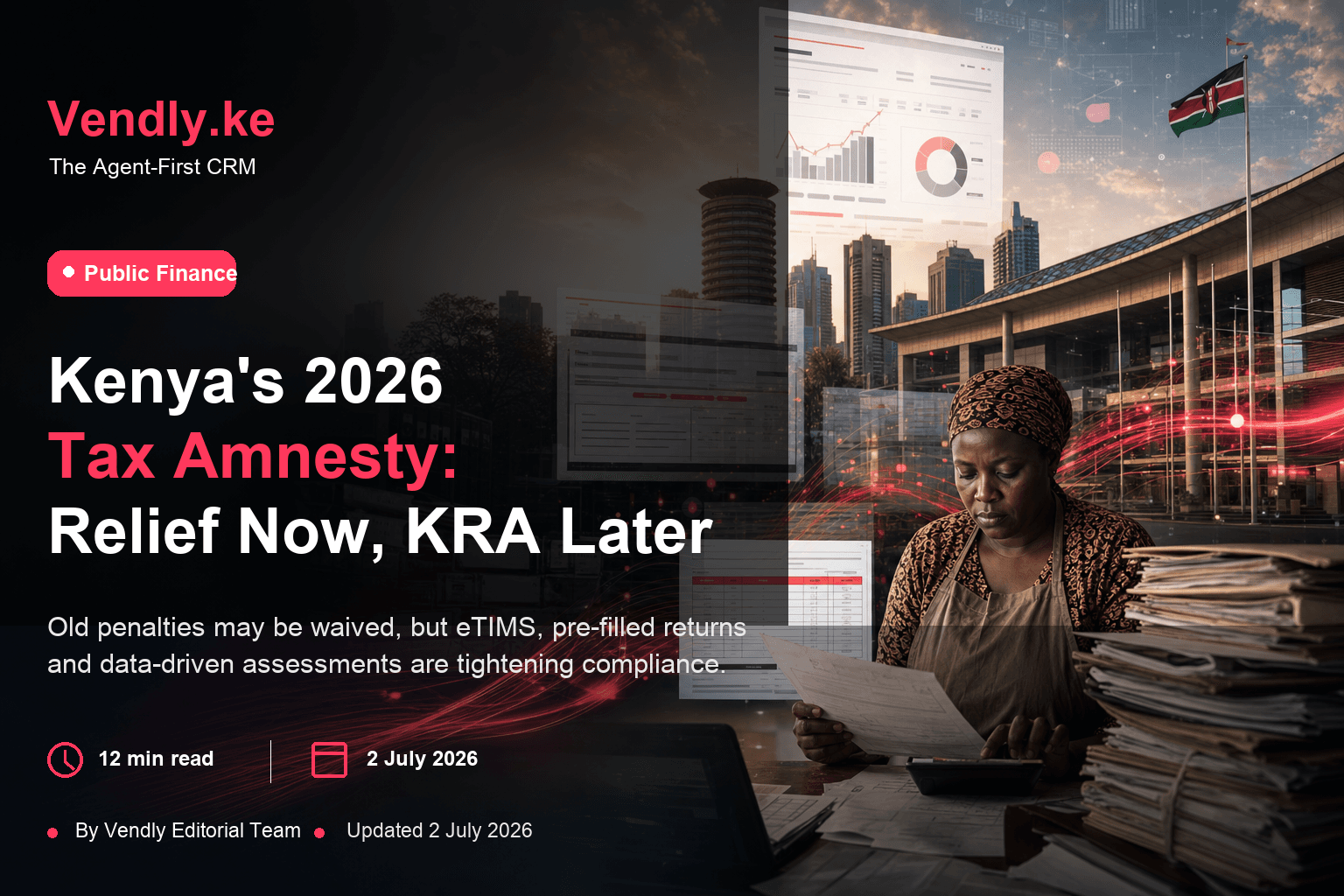
Kenya's 2026 tax amnesty looks generous on the surface: taxpayers with old principal tax liabilities can settle the principal and get relief from related penalties, interest and fines. But the bigger story is what comes after the amnesty. KRA is being positioned to enforce with more data, more electronic records and more system-generated assessments.
That makes this a carrot-and-stick moment. The carrot is relief on legacy penalties and interest. The stick is a tax system where eTIMS, withholding tax returns, PAYE records, third-party data, audit records, pre-populated returns and virtual-asset reporting make it harder to remain invisible.
For businesses, the practical message is clear: use the amnesty window to clean old issues, then fix recordkeeping before KRA's data catches up with you.
What the Amnesty Covers
The Budget Statement proposed an amnesty beginning 1 July 2026 for tax liabilities accrued up to 31 December 2025. Parliament's committee report describes a one-year amnesty running from 1 July 2026, with taxpayers qualifying for waiver of penalties, interest and fines if they pay the principal tax by 30 June 2027.
This matters because old tax debts often become unpayable because of accumulated penalties and interest. A business may be able to settle the original principal tax but not the penalty stack built over several years. Amnesty gives such taxpayers a route back into compliance.
| Area | What changes | What taxpayers should do |
|---|---|---|
| Legacy tax debt | Penalties, interest and fines can be waived when principal tax is settled | Review old balances before the window closes |
| Data-driven assessments | KRA can rely on third-party and electronic tax data | Reconcile sales, payroll, withholding and eTIMS records |
| Pre-populated returns | Returns may be generated using electronic tax data | Review, amend or object with evidence |
| eTIMS compliance | Penalties and expense deductibility rules become more important | Issue and keep valid electronic tax invoices |
| Virtual assets | Reporting framework increases transaction visibility | Prepare KYC, records and privacy controls |
Why Government Likes Amnesty
Amnesty can unlock revenue that would otherwise remain stuck in disputes, old assessments or taxpayer fear. The committee report says the earlier amnesty attracted 1.06 million applications, declared Ksh 54.5 billion in principal tax liabilities and collected Ksh 43.9 billion between September 2023 and June 2024.
Those numbers explain why Treasury returned to the idea. If the government needs revenue without raising every tax rate, recovering old principal tax is attractive. It brings cash in, clears part of KRA's arrears book and allows officials to focus enforcement on current and future compliance.
The Moral Hazard Problem
There is a fairness problem. If amnesties keep returning, compliant taxpayers can feel punished for doing the right thing on time. A taxpayer who filed, paid and absorbed cash-flow pressure may wonder why another taxpayer gets penalty relief after waiting.
Parliament's committee recognised this risk, warning that repeated amnesties may weaken voluntary compliance if taxpayers start expecting future waivers. That is why the follow-up enforcement matters. Amnesty only works as a reset if the period after it is stricter, clearer and more predictable.
The New KRA Enforcement Environment
The Finance Bill package gives KRA stronger tools to assess tax using information beyond a taxpayer's own return. The committee report refers to third-party sources, electronic tax systems, employer filings, audit records, withholding tax returns, PAYE records and eTIMS data.
For an SME, that means a tax return will increasingly be checked against other records: supplier eTIMS invoices, customer withholding certificates, payroll filings, bank-linked records, platform statements and industry data. A return that does not match the surrounding data may trigger questions even before a traditional audit begins.
Pre-Filled Returns Are Helpful, But Not Harmless
Pre-filled returns can reduce errors and save time, especially for taxpayers whose income is already visible in electronic systems. But the committee report also says safeguards are needed. Taxpayers should be able to review, amend or challenge pre-populated information and understand the data sources used.
That is important in Kenya because electronic records are not always clean. A supplier may issue a wrong invoice, a customer may withhold incorrectly, a payroll record may be outdated, or a system outage may affect filing. The taxpayer still needs books that can prove what actually happened.
Why Small Businesses Should Not Ignore It
Many small businesses ignore old tax balances because they look too large once penalties and interest are added. That is exactly where the amnesty can help. The business should not guess from memory. It should log into the KRA system, check outstanding obligations, compare them against its own records and separate principal from penalty amounts.
The danger is waiting until the final months. If the balance is wrong, the taxpayer may need statements, bank records, withholding certificates, VAT reconciliations, supplier invoices or old correspondence. Those documents take time to collect, especially for businesses that changed accountants or systems.
Where Disputes Will Come From
The next wave of disputes is likely to come from mismatched data. A buyer may claim an expense through eTIMS while the seller records a different amount. A withholding agent may file late. A payroll record may show a worker who has already left. A platform may report gross receipts while the taxpayer books net settlement after fees.
That is why the committee's safeguard language matters. Data-driven assessment should not mean automatic guilt. KRA should disclose the data source and computation, and taxpayers should be able to respond with proper books. The best defence for a business is not a speech. It is a clean reconciliation trail.
Amnesty Is Not Audit Protection
Businesses should also understand what amnesty is not. It is not a permission slip for weak filing going forward, and it does not replace proper tax advice where the principal amount is disputed. If the underlying liability is wrong, the taxpayer should resolve the assessment instead of blindly paying a figure just because penalties may be waived.
The safest approach is to treat amnesty as a settlement opportunity, then rebuild compliance habits immediately: monthly reconciliations, clean invoices, correct payroll filings, and documented explanations for unusual transactions.
What Businesses Should Do Now
- 1Download and review old KRA balances before the amnesty window moves too far.
- 2Separate principal tax from penalties, interest and fines so the real settlement amount is clear.
- 3Reconcile VAT, PAYE, withholding tax, income tax and eTIMS records monthly.
- 4Keep supplier invoices, customer statements, bank records and payroll schedules in one place.
- 5Challenge wrong pre-filled data early and support the objection with documents.
- 6Do not treat amnesty as a routine planning tool; assume enforcement will be tighter after 30 June 2027.
The Bottom Line
The 2026 tax amnesty is useful for taxpayers with old balances, but it is not a signal that KRA is becoming softer. It is more likely a reset before a more data-driven compliance phase. Businesses that use the window to clear principal tax and improve records will be better placed. Businesses that wait for another amnesty may find that eTIMS, pre-filled returns and third-party data have already closed the hiding places.