Key takeaways
- Zero-Rated vs Exempt: The Simple Version
- Mitumba: Relief for Local Traders, Not a Full Price Cut
- Dialyzers: A Direct Health-Cost Measure
- Solar, Lithium Batteries and BEV Stoves
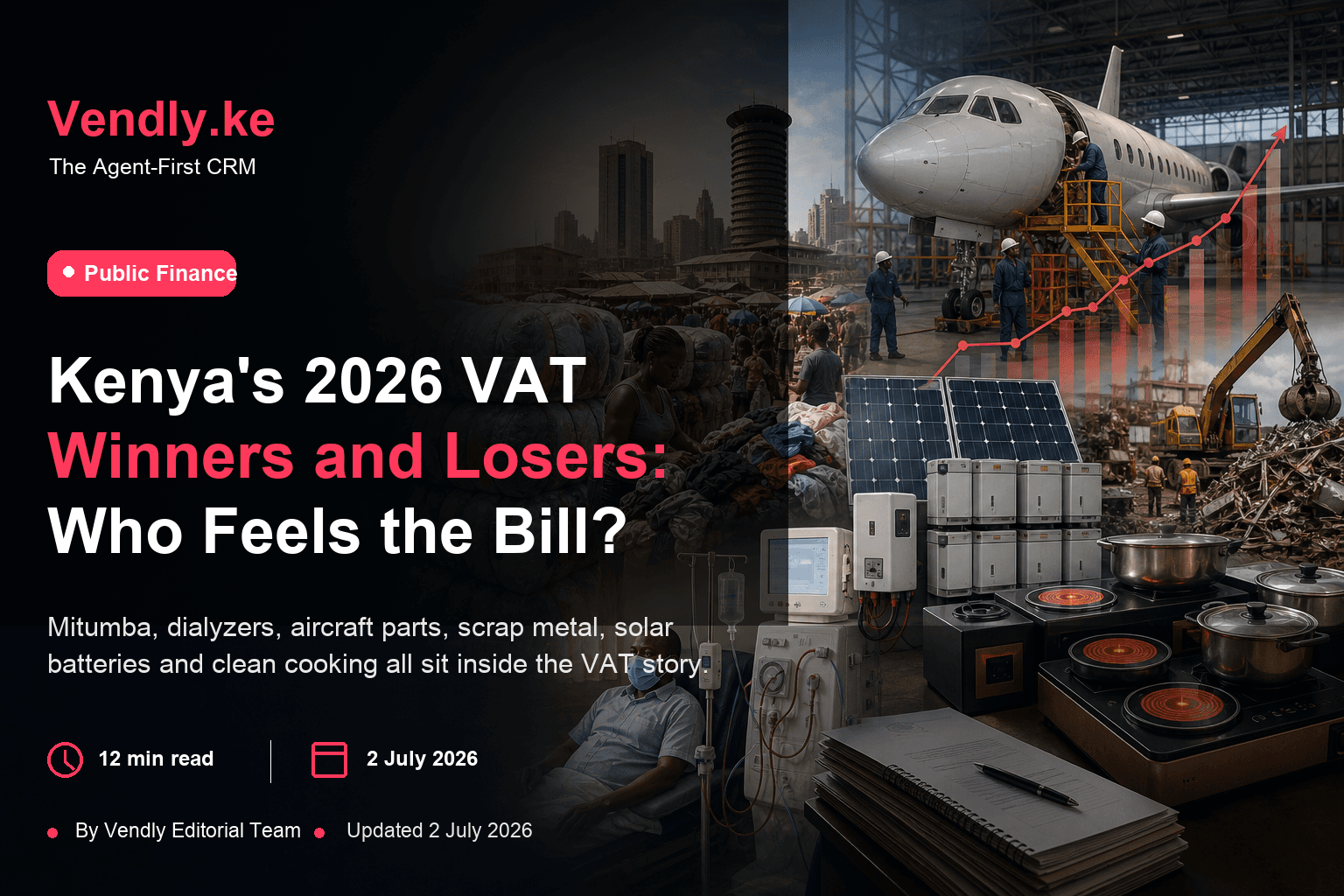
Kenya's 2026 VAT debate is not one story. It is several small price stories sitting inside one tax law: mitumba traders, dialysis patients, solar users, aircraft maintenance firms, PPP projects, scrap metal dealers, pharmaceutical manufacturers, animal-feed producers and clean-cooking businesses all appear in the same VAT conversation.
The important thing is to avoid treating every relief measure as the same. Zero-rated and exempt goods both sound friendly to consumers, but they work differently for businesses. Zero-rated supplies allow input VAT recovery. Exempt supplies generally do not. That difference can decide whether a policy lowers prices or quietly moves costs into the supply chain.
For businesses, zero-rated is usually stronger than exempt because input VAT can still be recovered. For consumers, the visible price may depend on whether suppliers pass the relief through.
Zero-Rated vs Exempt: The Simple Version
A zero-rated item is taxable at 0%. The seller can usually claim input VAT incurred in making that supply. That helps keep production costs lower. An exempt item is outside VAT charging at the point of sale, but the seller normally cannot recover input VAT on related costs. That unrecovered VAT can become part of the business cost and may still appear in prices.
This is why Parliament's committee paid attention to proposals that would move items from zero-rated to exempt status. On paper, both may look like relief. In practice, moving from zero-rated to exempt can increase production costs because input VAT is trapped.
| Item or sector | 2026 VAT treatment or debate | Likely winner or risk |
|---|---|---|
| Mitumba | VAT charged at importation, local sales exempt | Traders avoid domestic VAT paperwork, but import cost remains |
| Dialyzers | VAT exemption for kidney dialysis equipment component | Patients and hospitals may see lower treatment-equipment costs |
| Large aircraft and aircraft parts | VAT exemption protected in committee debate | Aviation maintenance and regional hub strategy benefit |
| PPP projects | VAT exemption retained for qualifying projects | Infrastructure financing gets cost relief |
| Scrap metal | VAT exemption plus 1.5% withholding tax debate | Formalisation improves, but traders worry about cash flow |
| Solar and lithium-ion batteries | Committee recommended retaining zero-rated status | Clean energy users and suppliers avoid trapped VAT |
| BEV stoves | Committee debate protected zero-rated treatment for clean cooking | Clean-cooking affordability and local supply chains benefit |
| Animal-feed inputs | Committee recommended retaining zero-rated status | Farmers may avoid higher feed-related costs |
Mitumba: Relief for Local Traders, Not a Full Price Cut
Treasury recognised that mitumba supports livelihoods and affordable clothing. The Budget Statement says VAT would be charged at importation while subsequent local sales of worn clothing and footwear would be exempt. That means a mitumba trader selling in Gikomba, Toi, Kongowea, Kisumu, Eldoret or a county market is not expected to account for VAT on every local sale.
This simplifies compliance in a highly informal sector. But it does not remove every tax cost from the bale. VAT at importation still affects landed cost. So the real question is whether the final shelf or market price falls, stays flat or only avoids rising further.
Dialyzers: A Direct Health-Cost Measure
Dialysis is expensive, frequent and unavoidable for many kidney patients. Treasury proposed VAT exemption for dialyzers, describing them as critical lifesaving components for patients experiencing kidney failure. Parliament's committee also recognised that the measure can help reduce the cost of dialysis treatment.
This is one of the clearer public-interest VAT measures. It targets a health input where households feel costs directly and repeatedly. The test will be whether hospitals, suppliers and insurers pass the benefit through to patients.
Solar, Lithium Batteries and BEV Stoves
The committee report shows strong concern about moving solar and lithium-ion batteries, electric mobility items and bioethanol vapour stoves away from zero-rated treatment. Stakeholders warned that shifting these items to exempt status could raise costs for off-grid power, clean cooking, e-mobility and local manufacturing.
For rural households and small businesses, these items are not luxury green products. Solar systems power shops, kiosks, farms, clinics, cold rooms and homes beyond reliable grid reach. Clean-cooking technologies reduce household fuel costs and health risks. This is why the zero-rated versus exempt distinction matters so much here.
Scrap Metal and Formalisation
Scrap metal was treated as a compliance and traceability problem. Treasury proposed VAT exemption for scrap metal and a withholding tax framework to bring more transactions into formal records. The logic is understandable because scrap metal is often cash-based and difficult to audit.
But for traders, cash flow is the issue. If withholding tax applies on gross sale amounts and input VAT recovery is limited, small dealers can feel squeezed even when the policy is meant to formalise the sector. The fairest implementation needs thresholds, clear records and quick credit recognition where applicable.
Aircraft Parts and PPP Projects
VAT relief for large commercial aircraft and aircraft parts supports Kenya's ambition to remain a regional aviation and maintenance hub. Aircraft maintenance is capital-intensive, cross-border and sensitive to tax cost. If Kenya becomes expensive, work can move to competing jurisdictions.
PPP project relief sits in the infrastructure story. If private partners are expected to finance roads, energy, water or public facilities, VAT treatment can influence project viability. The public should still demand transparency: tax relief should lower project costs, not only improve private returns.
Who Really Wins?
A VAT winner is not always the person named in the law. If an item is exempt but input VAT is trapped upstream, the supplier may still carry costs. If an item is zero-rated and input VAT is recovered, the relief is stronger. If a trader receives relief but the market has weak competition, consumers may not see lower prices.
The best way to judge these measures is by price behaviour and business cash flow after implementation. Dialysis patients should feel health-cost relief. Mitumba traders should face simpler compliance. Solar and clean-cooking suppliers should avoid sudden cost jumps. Farmers should not see feed costs rise because of a technical VAT reclassification.
The Bottom Line
Kenya's VAT changes show how technical tax wording becomes household cost. The difference between zero-rated and exempt may sound like accountant language, but it affects clothing, dialysis, clean energy, farming inputs, aviation and infrastructure. The public should ask one practical question for every VAT relief: who gets the benefit, and does it reach the final Kenyan paying the bill?