Credit notes — corrections, refunds and returns
Reverse all or part of an invoice you've already issued. Reduces output VAT and clears the buyer's balance.
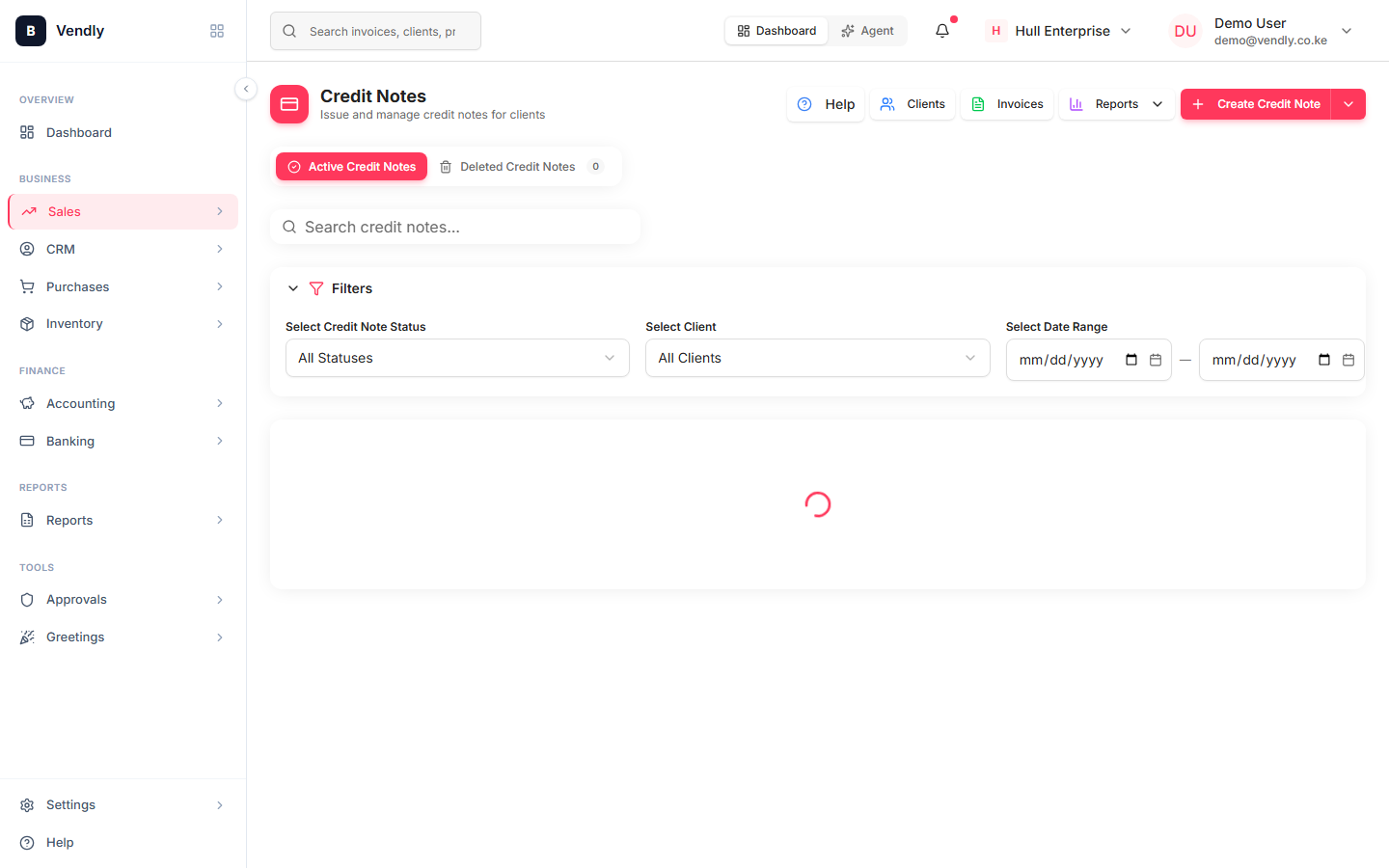
A credit note is the legal way to undo or reduce an invoice you've already issued. You cannot delete an invoice in Vendly (or in KRA's books) — every invoice number must remain traceable. Instead, issue a credit note that references the original invoice and reduces the buyer's outstanding balance.
When to use a credit note
- The buyer returned goods.
- You over-billed (wrong quantity, wrong price, double-billing).
- You billed the wrong client.
- Goods were damaged in transit.
- Negotiated post-sale discount.
Don't delete or 'void' an invoice that was already shared with the buyer or pushed through eTIMS. Issue a credit note instead — that's the audit-trail KRA expects to see.
Creating a credit note
- Sales → Credit Notes → New Credit Note.
- Pick the original invoice from the dropdown — the line items pre-fill.
- Adjust the quantities / amounts to reflect the actual reversal (full or partial).
- Optionally add a reason (return / pricing error / refund / etc.).
- Save and share with the buyer the same way you'd share an invoice.
What happens in the books
Approving the credit note posts a journal entry that reverses (partially or fully) the original invoice's AR and Sales lines, plus the output-VAT portion. The original invoice keeps its number — its outstanding balance simply reduces by the credit-note value.
VAT effect
The credit note's output VAT REDUCES your VAT3 return for the period the credit note is issued — NOT the original invoice's period. Keep this in mind for month-end reconciliation: a credit note issued in May against an April invoice reduces your May VAT, not April.
Refunding cash on a credit note? Record a separate Payment (outgoing) from the Banking module after issuing the credit note. The credit note clears the receivable; the payment clears the buyer's credit balance.
Kenya law that applies
- Value Added Tax Act 2013
Standard rate 16% VAT, exempt and zero-rated supplies, the KES 5m registration threshold, monthly VAT3 return.