Reorder rules and stock forecasting
Set a min level per product and Vendly tells you when to reorder. Let the forecast tell you HOW MUCH.
Running out of fast-moving lines is one of the highest-cost mistakes in inventory — the lost sale is bad, but the customer learning your competitor sells it is worse. Reorder rules turn 'what should I order this week' into a list.
How reorder rules work
Each Product carries an optional reorder level and reorder quantity. When on-hand stock falls at or below the reorder level, the product appears on the Reorder list. Click 'Create PO' and Vendly drafts a Purchase Order with the reorder quantity at the configured supplier — review and approve to send.
- Reorder level — trigger point. Set it to (average daily demand × lead time in days × 1.2 safety margin).
- Reorder quantity — how many to order. Set it to (average monthly demand) for monthly cycles, or (Economic Order Quantity) if you have a model.
- Preferred supplier — picks up automatically when creating the PO.
Start with reasonable estimates and tune monthly. The point isn't perfect numbers — it's never running out of the top 20% of SKUs that drive 80% of revenue.
Forecasting
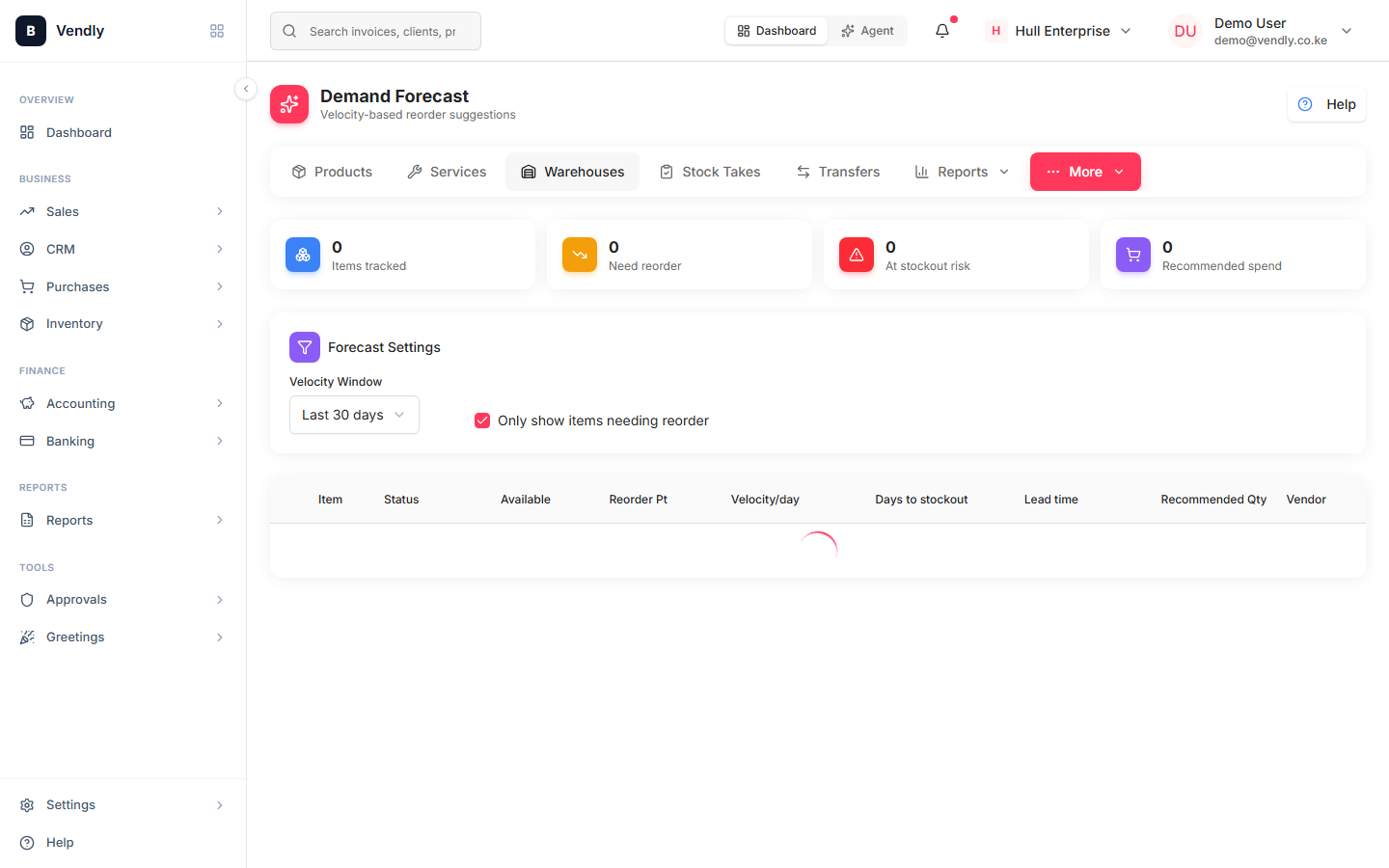
The Forecast page projects the next 30 / 60 / 90 days of demand for every product based on historical sales velocity. Use it to size your reorder quantity (especially for seasonal lines), spot trending-up items before they go out of stock, and avoid over-stocking trending-down items.
ABC analysis
| Tier | Definition | Restock approach |
|---|---|---|
| A — top 20% of SKUs | Drive ~80% of revenue | Tight reorder rules; never stock out; review weekly |
| B — middle 30% | Drive ~15% of revenue | Monthly reorder cycle |
| C — bottom 50% | Drive ~5% of revenue | Reorder only when ordered; consider dropping slow movers |
When NOT to use reorder rules
- Made-to-order or bespoke products — no sense reordering against forecast.
- Perishables with short shelf life — manual judgement on freshness beats a static reorder level.
- Brand-new products with no sales history — set a conservative first batch, then turn on reorder rules once you have 2-3 months of data.